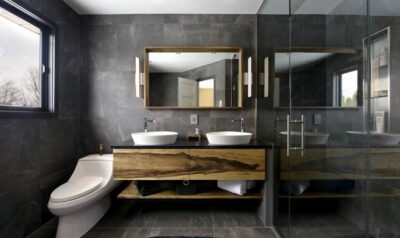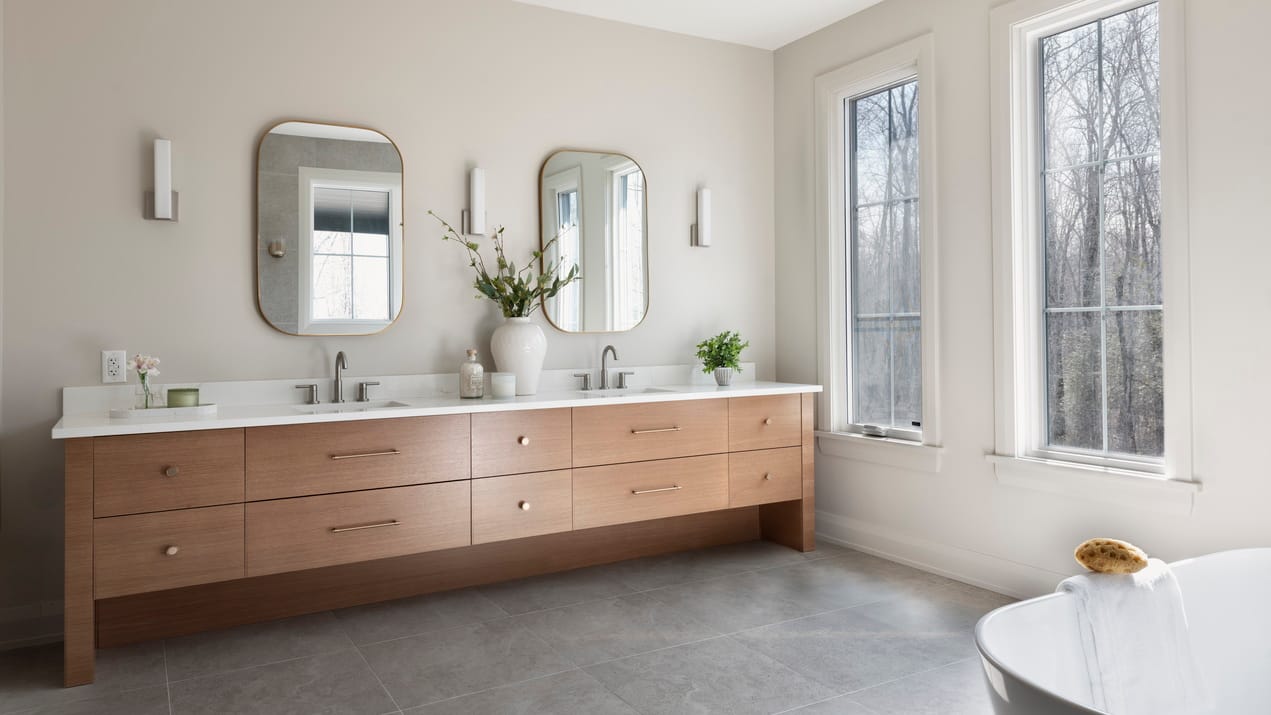
In a smaller space like a bathroom, every design choice carries weight. Your vanity is often the centrepiece, so it’s worth taking the time to choose one that works from the start. But how do you choose a bathroom vanity for your renovation or new home that looks good and functions the way you need it to?
Steps to choosing a bathroom vanity
Selecting a vanity takes thought and careful consideration. You need to take into account everything from utility and storage to design. These steps will help you collect all the information you need to make the right choice for your bathroom.
If you are renovating a guest bathroom or powder room, it won’t require as much planning. That means you have the freedom to have a little fun and make bolder style decisions without worrying about supporting your daily routines.
#1: Consider who will use the vanity, and how
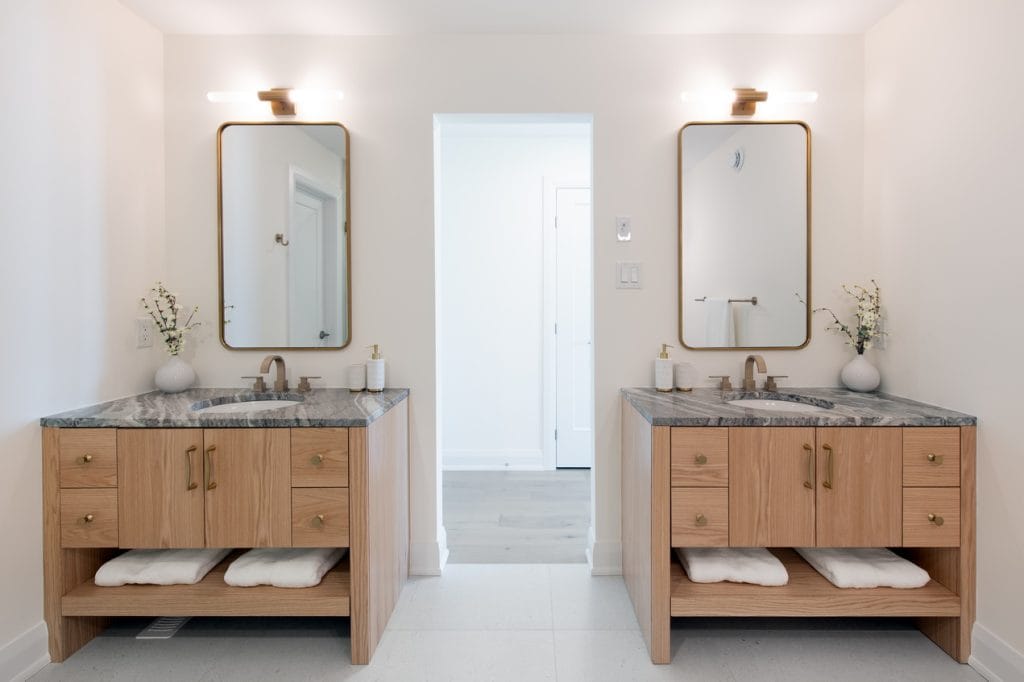
Your vanity choice should be guided by the people who will use it and what they will use it for. For example, if you and your partner compete for sink space in the morning, a double-sink vanity may be the right choice. However, if space is limited or a second sink isn’t necessary, a single vanity can be the right fit.
You also need to consider how you will use your vanity. If getting ready involves hair and makeup, you’ll want plenty of counter space and storage for your supplies.
#2: Determine where your plumbing is located
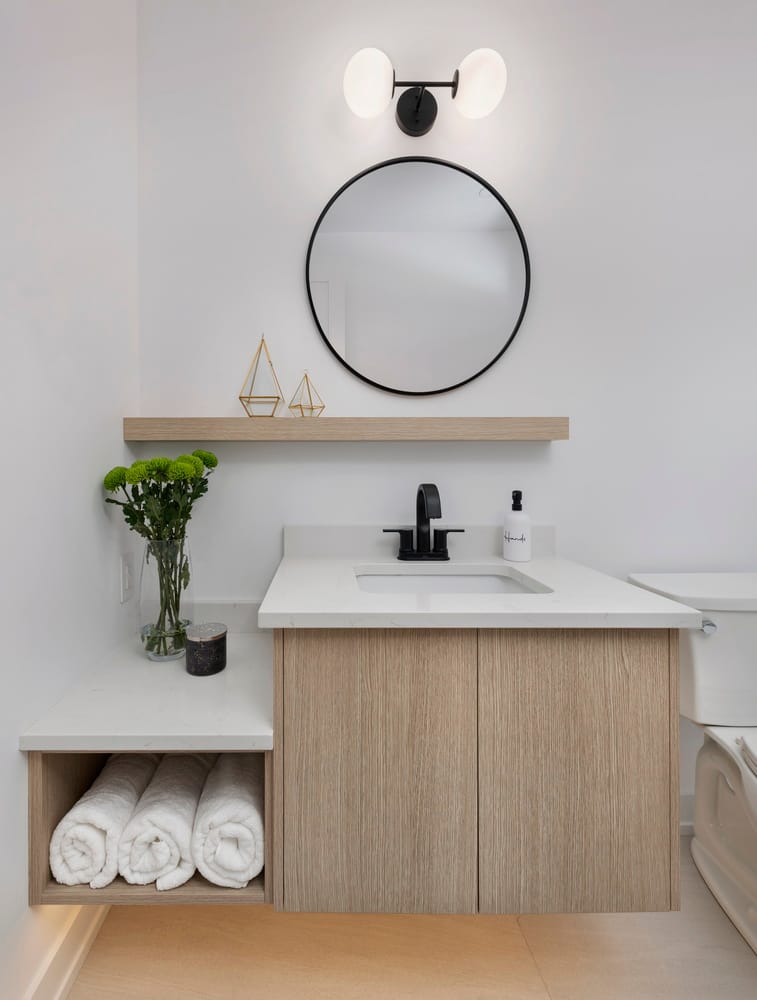
Plumbing will dictate where your vanity will go, because moving it comes at a price. It takes time and money to make plumbing changes.
This means that your plumbing will also have a say in the style you choose. For example, a floor-mounted vanity can make use of a typical plumbing layout. By contrast, a wall-mounted vanity may require relocating the sink’s plumbing hookups.
Moving the plumbing is not impossible; it depends on your needs and your budget for the project. If you do decide to work with the existing plumbing setup, it will help you narrow down vanity styles.
#3: Identify potential obstacles to determine placement and size
You can always change bathroom designs. Doors and walls, on the other hand, are more difficult to work around and will limit where you can place your vanity. Things you want to consider when determining placement include:
- Door swing: If your bathroom door swings inward and hits the vanity, it’ll be an impractical daily annoyance you don’t want to live with.
- Shower: Are you opting for a shower door instead of a curtain? This is something to account for when deciding where to place your vanity.
- Toilet: Do you want the vanity in front of, beside or well away from the toilet?
- Flow of traffic: Your vanity shouldn’t make it a challenge to navigate the rest of your bathroom. If you’re constantly bumping into it, frustration and bruises will inevitably follow.
Experiment by walking around the space. If you can’t visualize the layout completely, try using a vanity substitute, even a box will do. This stand-in will indicate where the vanity would be placed and how it would affect the rest of the room.
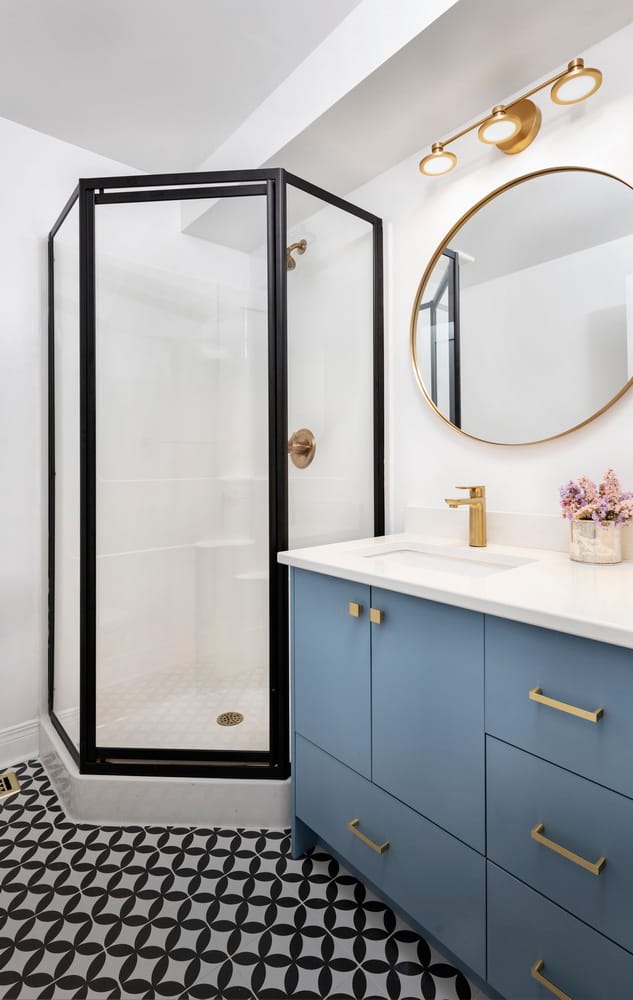
Once you have the rough placement, you can narrow down the size of your vanity. It needs to make sense given the size of your bathroom. This is where a tape measure comes in handy. You (or your contractor) will need to take some measurements to determine how long, deep and high the vanity can be, based on the factors above.
- Width: This measurement will indicate whether you have space for a single or double vanity. Most vanities are between 24 and 60 inches wide, but other lengths are available, especially if you have something custom-made.
- Height: Taller, “comfort height” vanities (up to 36 inches high) are frequently chosen for master bathrooms, while child-friendly standard height vanities (30 to 32 inches) are often used in guest bathrooms.
- Depth: A deeper vanity will increase storage space, so if room permits, go for it. Most vanities have a depth of between 17 and 24 inches.
The end result will be a set of measurements that will determine the area your vanity will occupy, allowing you to move to the next step.
#4: Establish the type of vanity you need
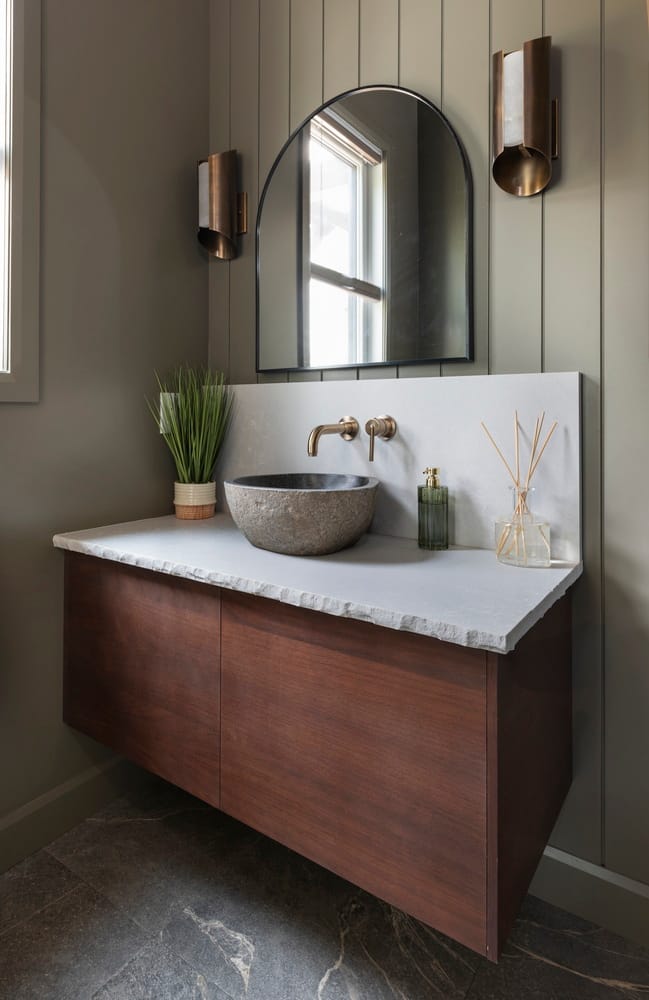
Before you dive into styles and finishes, it’s essential to select the right type of vanity that suits your bathroom and how you plan to use it.
Single-sink: Ideal for smaller bathrooms or powder rooms, single-sink vanities provide much-needed storage without taking up too much space. You can also opt for a single sink in a larger vanity to maximize countertop space.
Double-sink: Perfect for shared bathrooms, double-sink vanities offer the added convenience of allowing two people to use the space at once. Double-sink vanities are also larger, providing you with more storage space as well.
Wall-mounted: Wall-mounted vanities, also known as floating vanities, create a clean, airy, modern look while maximizing floor space, a favourite choice for contemporary bathrooms.
Freestanding: A classic choice for many bathroom designs, freestanding vanities combine flexibility and timeless appeal, often creating a finished-furniture look.
Corner: Corner vanities have a compact, wedge-shaped design and a single sink. They’re ideal for tight spaces, like powder rooms or guest bathrooms. Turn to a talented designer to make the most of this layout, ensuring it feels intentional and not cramped.
#5: Select a vanity design style that suits your space
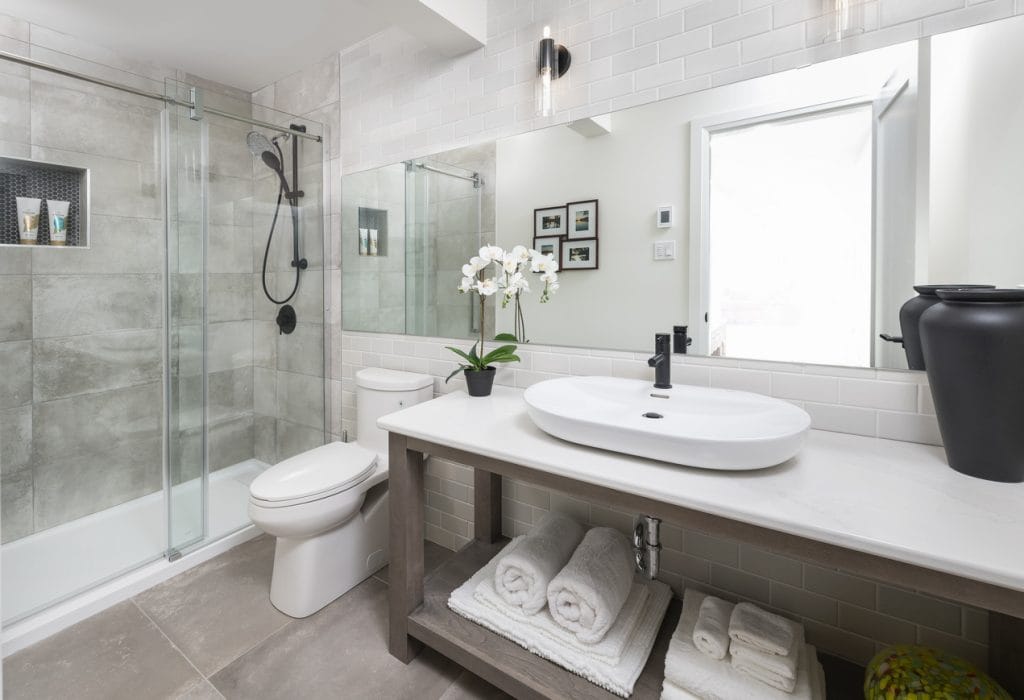
Bathroom vanities come in a variety of styles to suit every taste and space.
Modern: Sleek, minimal and often spa-inspired, modern vanities feature clean lines and calming colour palettes. Floating vanities, vessel sinks and natural materials like wood and stone are popular in this style.
Traditional: Grounded in classic design, traditional vanities often feature decorative, furniture-like designs. These vanities bring warmth and polished elegance to your bathroom.
Transitional: A perfect blend of traditional charm and modern simplicity, transitional vanities offer flexibility and timeless appeal. Think clean lines paired with softer finishes and contemporary hardware.
Of course, bathroom design is all about balance. Your vanity may lean toward contemporary or classic, while other elements, such as lighting, tile and even flooring, might introduce rustic warmth, mid-century charm or luxury. An expert designer can help you pull it all together to create a space you’ll love.
#6: Determine your storage needs
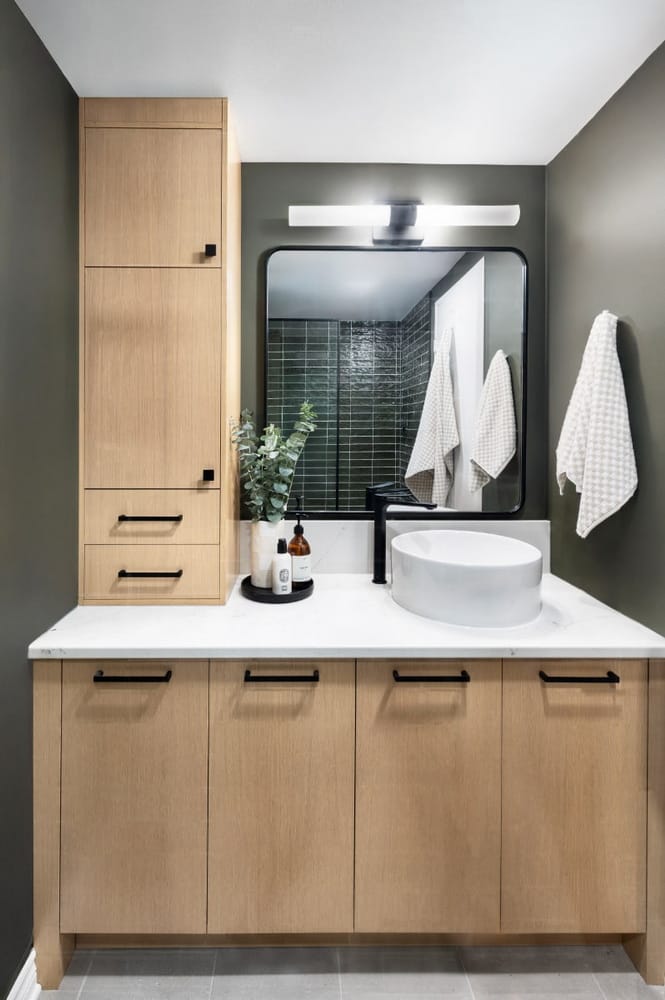
One of the perks of a vanity is the extra storage it offers. You’ll finally have a place to put everything.
Depending on the space and what you need to store, some compromises may be necessary. For example, you may be unable to accommodate three columns of drawers and still have room for the sink plumbing.
Drawers and cabinet doors take up space differently; drawers extend outward, while doors swing out and to the side. Depending on your bathroom’s layout, one may work better than the other. Whichever style you choose, there are plenty of organizational tools to help you get the most out of your storage with minimal hassle.
#7: Choose a sink style
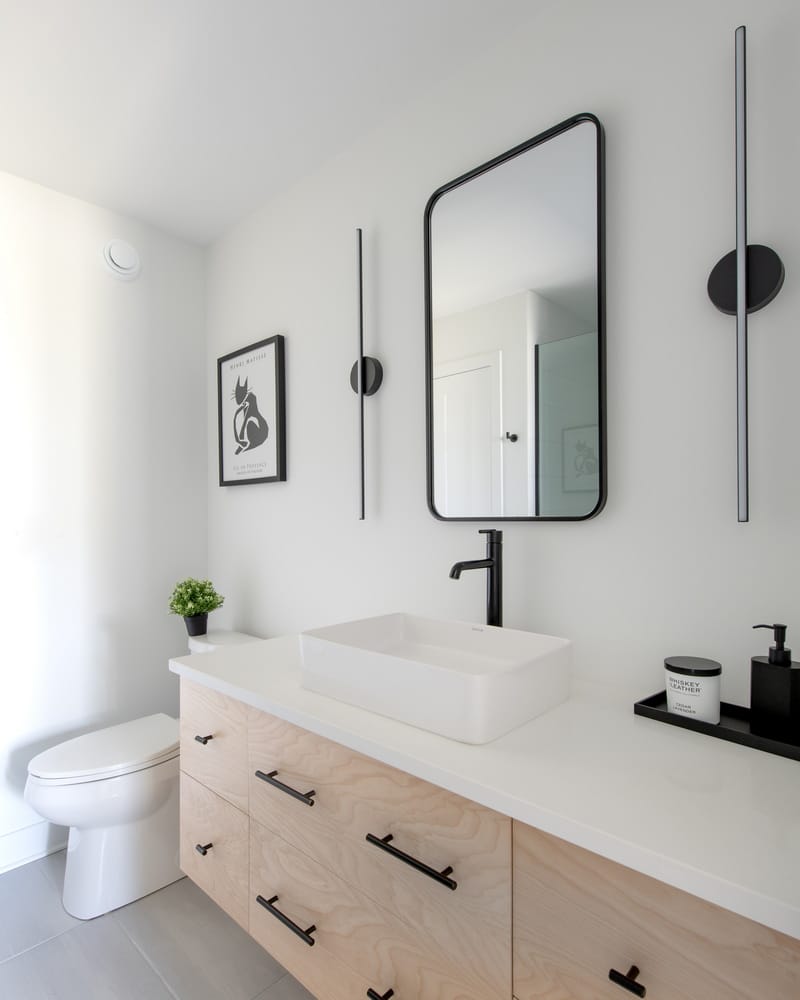
It’s fun to spend time selecting your faucet and taps, but don’t forget that they are only one part of the sink. The bowl deserves equal consideration because it will impact the look and utility of your vanity.
With so many sink styles available, it can be overwhelming to pick the one you’ll like the most. To quickly narrow your options, begin by determining the balance you want between sink size and counter space.
The sink will take up some countertop space no matter the style, but you can minimize its impact by choosing the right one. Compare standard sinks with vessel, undermount and integrated (or “all-in-one”) styles to get a clearer picture of how you want your vanity to look and function.
The size of your sink will also depend on your priorities for the vanity. For example, if you’re working with a limited surface area because floor space is scarce, a smaller sink will be ideal.
#8: Choose cabinet materials that work hard and look great
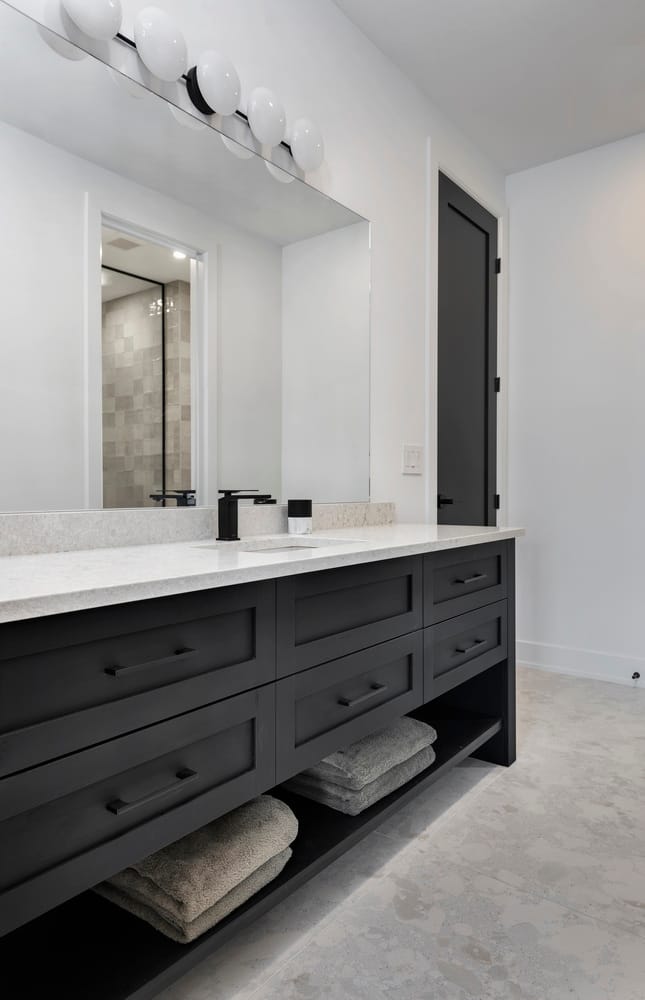
Your vanity is likely to come into contact with a variety of substances: water, makeup, personal care products, household cleaners and more. It’s also going to exist in a humid environment.
This means you need a vanity cabinet material that’s durable and can withstand whatever life throws at it. Certain materials are better suited to warm, moist climates than others. And, while you may like the look of one material or finish, it may not be waterproof or could be susceptible to staining or scratches.
Melamine: This durable surface is fused directly to a composite core, like particleboard or MDF. Melamine is moisture-resistant, easy to wipe clean and available in wood-look finishes that evoke warmth without the maintenance real wood requires.
High-pressure laminate (HPL): HPL is a durable, low-maintenance option for bathroom cabinetry, offering scratch resistance. It comes in a range of colours and textures, offering flexibility in design for your bathroom vanity.
Medium-density fibreboard (MDF): MDF holds paint beautifully and won’t warp like solid wood can in humidity. When sealed properly, it provides a clean, crisp look and holds up well in bathrooms.
Polyester: Made from melamine and pine fibre with a resilient polyester film covering, it resists humidity and daily wear, making it an ideal material for bathroom cabinet doors.
Wood veneer: If you love the look of real wood, a veneer is a smart way to bring natural texture into your bathroom without risking the expansion and contraction that can happen with solid wood. Note that in high-humidity environments, like bathrooms, veneers can be prone to warping or peeling, so they require proper sealing and good ventilation.
Thermofoil: Thermofoil cabinet doors are made by applying a heat-fused vinyl layer to a fibreboard core. They’re smooth, affordable, and easy to clean. However, they don’t love heat and moisture, so some care is needed when using hair tools or steam.
Acrylic or PET (Polyethylene Terephthalate): These ultra-smooth, modern finishes (available in high-gloss and luxurious matte) are scratch-resistant but not invincible. They’re easy to clean and moisture-resistant, making them a perfect choice for contemporary vanities.
#9: Pick the perfect countertop
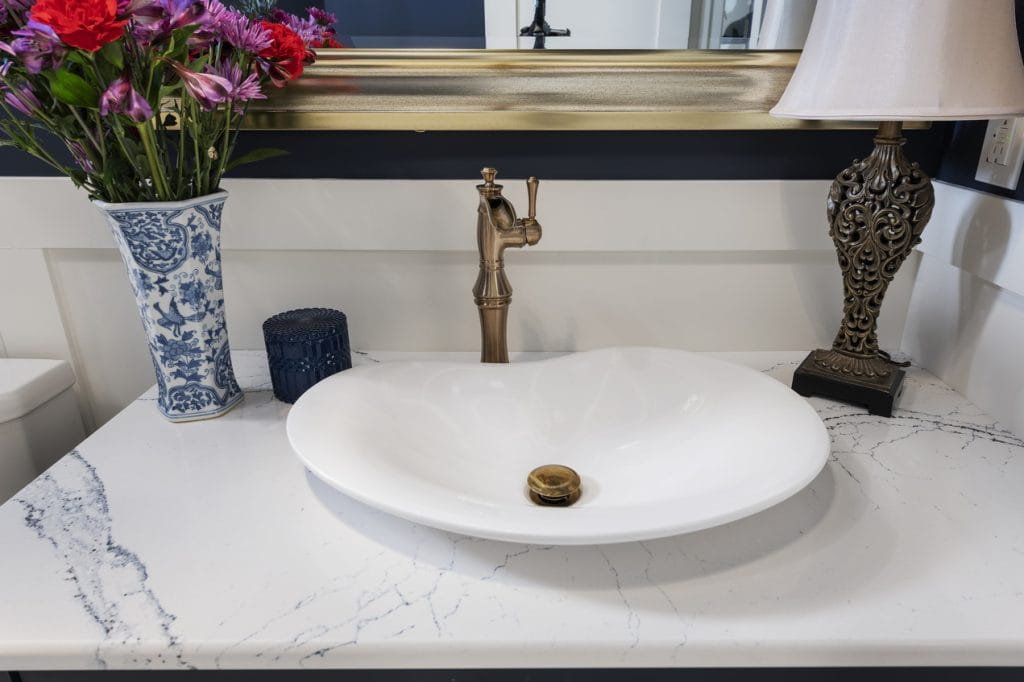
Choose a durable vanity top that doesn’t require grout, which is hard to clean. Explore countertop materials like natural stone, quartz and more to find an option that’s as beautiful as it is functional.
Quartz: A popular choice for bathroom vanities. It’s a non-porous engineered stone product that is resistant to moisture and staining and easy to clean. You also don’t need to seal it, making it a low-maintenance option.
Solid surface: Solid-surface countertops, such as Corian, are also ideal for bathrooms. They are seamless, non-porous, and naturally resistant to moisture, staining and bacteria. Solid-surface countertops do not require sealing and are easy to maintain with soap and water or a gentle household cleaner.
Porcelain: Porcelain slabs (or sintered materials like Dekton) are extremely dense and durable, making them highly resistant to scratches, heat and chemicals. For extra-large vanities, a seam might be unavoidable, but skilled installers can minimize the visibility of seams with colour-matched grout and expert alignment.
Natural stone: Granite, marble and soapstone are undeniably beautiful in bathrooms, but it’s important to note that natural stone is more porous, meaning it requires sealing to prevent staining and etching. If maintained properly, many find that natural stone countertops in bathrooms are well worth the effort.
Laminate: Today’s high-pressure laminates are water-resistant, easier to clean and available in a broader range of finishes than they used to be. While laminate is economical, it’s not as heat- or scratch-resistant as other materials.
#10: Custom vs. prefab bathroom vanities
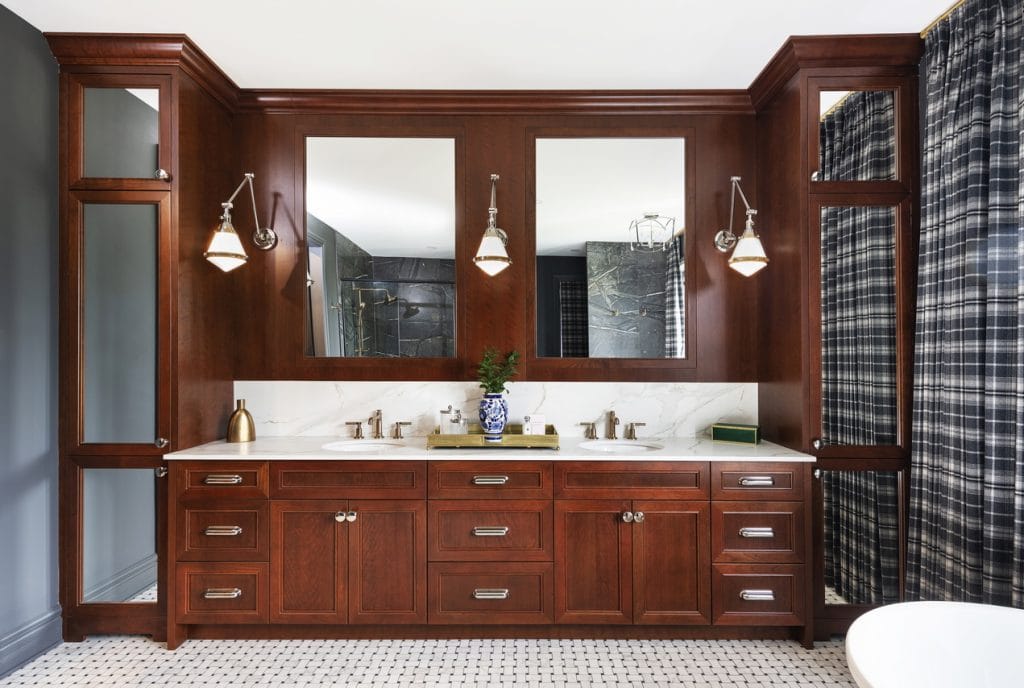
Custom vanities are always impressive. They are often made from the finest materials and fit perfectly in a room because they are designed for the space.
When you order a custom piece, you personally choose the size, base, countertop, backsplash, sink and all the hardware. Achieving that level of craftsmanship takes time and comes with a higher price point, but the result speaks for itself.
Prefab vanities are less expensive, but they come with trade-offs. Durability may not match that of a custom-made piece, and customization options are limited. Prefab vanities come in standard dimensions, with a shorter list of colours, stains, countertop materials, sinks and fixtures to choose from. On the plus side, they tend to arrive much faster than custom cabinetry.
#11: Make it your own
Above all, your renovation should look the way you want it to. This includes choosing your bathroom vanity. By the end of the process, your vanity should look like a vanity you can’t wait to use and keep forever.
There are no wrong choices. Design experts can help you with this process and help you get the vanity and bathroom you’ve always dreamed of.