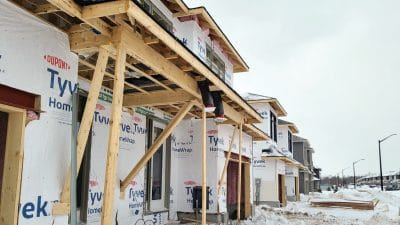
The housing platforms of municipal candidates in the upcoming election promise to be a key factor in who wins a seat in the mayor’s office and around the council table.
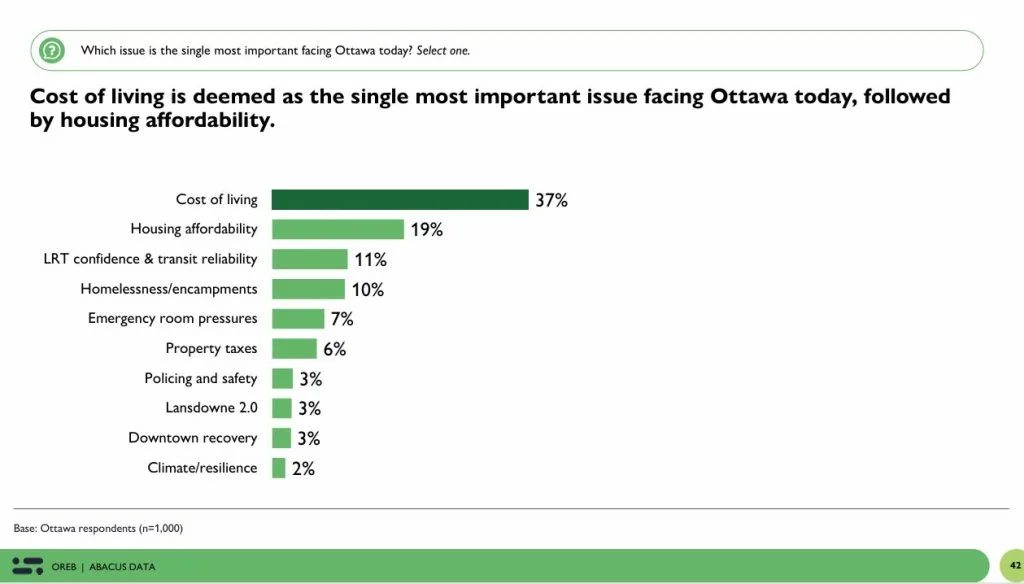
A survey released earlier this year found that 82 per cent of Ottawa residents said housing-related issues would be important in determining who they support in the election. The survey, conducted by Abacus Data for the Ottawa Real Estate Board, also found that housing affordability was the second-most important issue facing Ottawa, while an earlier survey by Abacus for the board learned that 74 per cent of respondents believed housing was unaffordable in Ottawa.
Housing affordability has improved somewhat thanks in large part to the temporary removal of HST for new-build homes (the resale market has not benefitted from a similar removal, but year-to-date prices have slipped slightly compared to the same period in 2025). Nonetheless, housing and homelessness remain hot topics in the city which, like much of the province, has fallen far behind in the race to build 151,000 homes by 2031, a goal that was in keeping with the Ford government’s 2022 election promise to create 1.5 million new homes province-wide by 2031.
On Oct. 26, Ottawa residents will vote for a mayor and councillors as well as school board trustees. A total of 181 candidates have been certified, including 10 by acclamation. All Things Home asked all candidates for mayor and councillor for their platforms on five housing-related matters:
Homelessness
What specifically is your plan to solve our homelessness problem?
Affordable housing
What else will you do to support increased construction of affordable housing and what’s your timeline on those initiatives?
Intensification
The city has a long-term target of accommodating 60 per cent of housing growth in established areas. Do you consider that target realistic?
Zoning
The city made substantial changes to zoning bylaws in January, including allowing three-storey dwellings nearly everywhere. Would you push for more zoning changes and, if so, what?
Official plan changes
The provincial government has given the city the power to make Official Plan changes prior to the mandatory five-year review. Is this a power the city should use and, if not, why not?
Other
Does your housing platform include any other areas not mentioned here? Please elaborate.
Here’s what those candidates who responded said.
Content lightly edited for style and clarity.
Jump right to:
Mayoral candidates
Ward 1 candidates
Ward 4 candidates
Ward 6 candidates
Ward 8 candidates
Ward 10 candidates
Ward 12 candidates
Ward 13 candidates
Ward 14 candidates
Ward 17 candidates
(Other candidates will be added as they respond)
Mayoral candidates
Mayor Mark Sutcliffe
Homelessness & affordable housing
Mark Sutcliffe’s plan to end homelessness in Ottawa includes funding 650 new supportive housing units in the next five years. Sutcliffe will also increase the number of affordable homes by 10,000 compared to 2020. The Sutcliffe plan also includes strengthening and expanding the mandate of Ottawa Community Housing so they can move faster and do more.
The plan will make it easier to build affordable housing on municipal land and incentivize and develop a greater number of affordable three-bedroom units for low-income families. By working with partners including Habitat for Humanity and Ottawa Community Housing, Sutcliffe will develop an affordable homeownership strategy with the goal of giving more families the opportunity to own their own home.
Intensification
We must do everything we can to achieve greater infill, particularly in areas that are already highly urban and near transit stations. The city’s updated zoning bylaw, one of the most forward thinking in the country, makes this kind of intensification much easier to achieve.
Zoning
The city’s updated zoning bylaw is one of the most ambitious and forward-thinking in the country. It encourages higher density in urban areas and near major transit stations while permitting gentle density in communities across the city. It followed broad consultation and support from throughout the community, and it was approved unanimously at council. We do not anticipate making further changes at this time.
Official Plan changes
Ottawa’s new Official Plan is set to be reviewed during the coming term of council. We do not intend to conduct major Official Plan changes outside of regular review periods.
Other
No response
Ali Shayvard
Homelessness
Homelessness cannot be solved by addressing only what we see on the street. We need to address the root causes. For some people, that means mental-health or addiction support; for others, it may mean job loss, family circumstances, or simply being unable to afford housing in Ottawa anymore.
My approach is to make sure people experiencing homelessness have access to safe shelter and the appropriate supports to help them transition into stable housing. At the same time, we need to prevent people from becoming homeless in the first place. That is why a major part of my homelessness strategy is directly connected to my affordable-housing plan.
Affordable housing
We need to stop treating the word “affordable” as a slogan and start producing housing that Ottawa residents can actually afford.
I want the city to work with developers so that when significant new residential developments are built, affordable units are incorporated into those communities wherever legally and financially feasible. At the same time, we need to protect existing affordable housing and tenants. Development should not simply transform a neighbourhood by displacing the people who have lived there for years.
I also want the city to identify appropriate publicly owned and developable land where we can accelerate affordable and mixed-income housing, particularly in locations that can be properly connected to transit and essential services.
This work would begin in my first year. I would want an inventory of suitable land, a review of the barriers delaying affordable construction, and clear targets so residents can actually measure our progress.
Intensification
I believe the 60 per cent target can be achievable, but it should not become an excuse for poor planning.
Ottawa should absolutely build more housing within established areas, particularly around transit corridors and places where infrastructure can support additional residents. However, intensification needs to be balanced with infrastructure, schools, parks, transportation and the existing character of communities.
My position is not simply “build everywhere” or “build nowhere.” It is to build intelligently. If we are adding thousands of residents to an area, the infrastructure and services supporting those residents need to grow with them.
Zoning
I am open to further zoning reform where it helps us create more housing, but I do not believe zoning changes alone will solve the affordability crisis.
I support allowing a greater variety of housing, including duplexes, triplexes and other forms of gentle density in appropriate locations. I would particularly look at opportunities for additional density near major transit corridors and stations.
At the same time, residents deserve meaningful consultation. We can increase the housing supply without giving developers a blank cheque to completely reshape established communities without considering the people already living there.
Official Plan changes
Yes, I believe the city should be willing to use this power when there is a clear public-interest reason to do so. We should not make changes simply because we have been given the authority, but we also should not wait five years to correct something that is clearly preventing good housing, transportation or infrastructure planning.
Any significant change should be evidence-based, transparent and include meaningful public consultation. Residents should be able to understand what is being changed, why it is being changed, who benefits from it and what impact it will have on their community.
My approach would be simple: use the power when it helps Ottawa solve a real problem and serves the public interest, not simply because developers or politicians want a faster process.
Other
No response
Councillor candidates
Ward 1: Orléans East-Cumberland
Barbara Daniela Gandolfo
Homelessness
Investing in and preserving existing affordable housing is a key component to ending homelessness. Permanent funding and city-wide expansion of ANCHOR (Alternate Neighbourhood Crisis Response) would also provide critical points of contact and wrap around services to vulnerable individuals experiencing mental-health struggles and substance use.
Affordable housing
An integrated approach of adaptive reuse — converting vacant commercial buildings into residential units — and contributing municipally owned vacant land to lower initial project costs for non-profit builders.
Intensification
A 60 per cent intensification target by 2046 is ambitious, but in partnership with other jurisdictions of government is achievable. Intensification offers a sustainable growth option that focuses on neighbourhood renewal with improved access to transit services, schools, amenities and social interaction — particularly beneficial to an aging population.
Zoning
The new zoning bylaws were a sweeping overhaul of zoning rules, passed with the intention to make building easier in Ottawa. The changes received wide support and were already quite ambitious.
Official Plan changes
Official Plan changes should be based on the findings of well-researched background studies and public consultation — with a balanced approach between environmental, economic and social factors to make the most informed land use decisions.
Other
No response
Ward 4: Kanata North
Rob Millan
Homelessness
I do not see chronic homelessness as simply a housing shortage. Addiction, untreated mental-health issues and behavioural issues are major parts of the problem, and providing housing alone does not solve them. Ottawa needs substantially more treatment and rehabilitation capacity and better co-ordination between shelters, health services and police. Much of that falls under provincial jurisdiction, so the city also needs to be much more aggressive in pushing the province for that capacity.
Affordable housing
Affordability is largely a supply problem. The most impactful thing the city can do is reduce the cost and time it takes to build housing: faster approvals, predictable timelines, fewer unnecessary barriers, and more housing types. That is where I would focus first, rather than creating new municipal spending programs.
Intensification
I think the 60 per cent target is realistic as a long-term, city-wide goal, but only if infrastructure keeps pace. The best opportunities are around transit, major roads and commercial and employment areas. Some additional density also makes sense within established neighbourhoods, but water, sewer, stormwater, roads and transit still must support it.
Zoning
The new zoning bylaw was a major overhaul, and I support the general direction. I would not immediately start another blanket city-wide rezoning exercise when we have barely seen the effects of this one. I would focus on faster permitting, then make targeted zoning changes where they make sense, particularly around transit and in places like the Kanata North Tech Park where more residential density can support jobs, businesses and better transit.
Official Plan changes
Yes. Conditions can change faster than a five-year review cycle. The city should be able to make targeted changes when infrastructure, housing needs or economic conditions have materially changed. It should not become a way to make one-off exceptions without a proper planning rationale.
Other
Housing growth and economic growth need to go together. My platform puts a major emphasis on growing Ottawa’s commercial tax base, particularly in the Kanata North Tech Park. A stronger commercial tax base gives the city more capacity to pay for infrastructure and services without continually pushing the burden onto residential property taxpayers.
Ward 6: Stittsville
Marie-Ange Yindaki Ahinful
Homelessness
I do not believe homelessness can be solved simply by adding more shelter beds. Shelters are an important emergency response, but they should not become permanent housing.
I support a housing-first approach that combines permanent and supportive housing with mental-health, addiction, employment and other supports where they are needed. I would also put greater emphasis on prevention. Helping someone remain housed is often more effective and less costly than trying to rehouse them after they become homeless.
Ottawa’s new 2026–2035 Housing and Homelessness Plan already recognizes the importance of housing, prevention and co-ordinated supports. As councillor, I would push for clear annual targets and transparent reporting so residents can see whether those commitments are producing results.
Homelessness is also not something the city can solve alone. I would advocate strongly for sustained provincial and federal investment, particularly for supportive housing, mental-health and addiction services.
Affordable housing
We need more housing across the entire spectrum: affordable rental housing, supportive housing, co-operative housing, market rentals and attainable homeownership.
My priority would be removing unnecessary municipal barriers that delay construction while protecting good planning. That includes faster and more predictable approvals, making better use of suitable city-owned land, supporting partnerships with non-profit and co-operative housing providers, and using available municipal incentives strategically.
Ottawa already has tools including Action Ottawa and property-tax exemptions for qualifying non-profit and co-operative affordable housing. I would support expanding and improving these tools where evidence shows they are actually producing affordable units.
I would begin that work immediately upon taking office. Within the first year, I would want council to establish measurable objectives for approvals, affordable units and the use of available city land, followed by public annual reporting. I would not promise that thousands of homes can appear overnight — the construction process simply does not work that way — but I would expect the city to demonstrate measurable progress every year.
Intensification
I believe the 60 per cent target can be achievable, but it needs some clarification. Ottawa’s Official Plan does not require 60 per cent intensification immediately. The target increases progressively, reaching 60 per cent for the 2042–2046 period.
I support responsible intensification because continually expanding outward creates its own infrastructure and financial pressures. But intensification must be planned properly.
For Stittsville, this is especially important. Residents can see the community growing rapidly, and understandably ask whether transportation, recreation, schools, parks and other infrastructure are growing with it.
I therefore support directing greater density toward appropriate corridors, hubs and areas that can support it, rather than treating every street and neighbourhood exactly the same. In fact, Ottawa’s Official Plan itself directs significant intensification toward hubs, corridors and neighbourhoods within walking distance of them.
My position is simple: growth and infrastructure must go together.
Zoning
I support the objective of making it easier to create different types of housing. The new comprehensive zoning framework is intended to increase housing supply and housing choice while implementing Ottawa’s Official Plan.
However, after such a substantial zoning change, my first priority would be implementation and monitoring rather than immediately pursuing another city-wide rezoning exercise.
I would look at additional zoning changes where there is evidence of a specific barrier — for example, facilitating housing near transit and appropriate commercial corridors, making conversions easier, or removing regulations that unnecessarily prevent reasonable housing projects.
At the same time, zoning cannot be considered independently from infrastructure capacity, neighbourhood context, trees and greenspace, transportation and quality of life.
I am pro-housing, but being pro-housing does not mean saying yes to every development regardless of its impact.
Official Plan changes
Yes. If the city now has greater flexibility to amend its Official Plan before the mandatory five-year review, I believe council should be willing to use that authority when there is a demonstrated need and strong evidence supporting the change.
The Official Plan should guide long-term growth and should not be rewritten every time a particular development proposal comes forward. Residents, businesses and developers all benefit from predictability.
However, Ottawa is changing quickly. If population growth, housing needs, infrastructure capacity or other circumstances demonstrate that a policy is no longer working, council should not have to wait years to correct it.
I would therefore support targeted, evidence-based amendments accompanied by proper public consultation — not constant ad hoc changes.
Other
One area I believe deserves much more attention is housing choice throughout every stage of life.
Housing policy is not only about how many units we build. We need family-sized homes, accessible housing for people with disabilities, rental options for young adults, affordable homes for first-time buyers, and appropriate options for seniors who want to downsize while remaining in their communities.
I also want Ottawa to focus more aggressively on preserving the affordable housing we already have. Building new affordable housing while simultaneously losing existing affordable units will not solve the problem.
Finally, I would bring a strong infrastructure lens to housing decisions. Ottawa needs more homes, but residents should not be forced to choose between housing growth and livable communities. New housing needs to be co-ordinated with transportation, transit, parks, recreation, emergency services and other municipal infrastructure.
Ottawa is going to grow. The question is not whether we grow, but whether we grow well.
My goal would be to ensure that growth creates communities where families can afford to live, children can grow up, seniors can remain, businesses can thrive, and residents continue to enjoy a high quality of life.
MORE: Inaugural Ottawa housing symposium explores challenges and solutions
Ward 6: Stittsville
Theresa Qadri
Homelessness & affordable housing
As a candidate for Ward 6, one of the fastest growing Ottawa wards, and as the chair of the Stittsville Food Bank (currently on leave while running my campaign), I am sensitive to the diverse housing and affordability needs in my community. In Ward 6, our understanding of homelessness and affordability needs is still emerging.
Let me be clear: I will ensure that Ottawa’s Affordable Housing Capital Strategy aligns and supports my ward needs as well as evolving provincial and federal housing perspectives.
At the time of this response, the city has received more than 30 applications for new development, which would result in more than 11,000 mixed-type housing units. My commitment is to work with everyone for the benefit of Ward 6: complete communities with appropriate infrastructure, a balanced approach for a world-class Stittsville.
Intensification
Stittsville is being directly impacted by provincial decisions on expansion of urban boundaries. Intensification in our ward must be planned properly and each infill location must be addressed uniquely.
Zoning
With respect to zoning changes, Stittsville development must occur carefully. When zoning change discussions are tabled, we will work with everyone on a case-by-case basis.
Official Plan changes
I want to review the existing CDPs (Community Design Plans) and the planning interaction/process between city and province to ensure I have a current understanding. I also want to hear from builders and developers in Ward 6 to ensure we understand common goals in that broader setting and potential community benefit and an effective working relationship.
Other
No response
Ward 6: Stittsville
Kevin Hua
Homelessness
I would like the city to support and invest more in working with non-profit housing providers to ensure more truly affordable housing is available and continuing to build up the city’s housing first strategy in its Housing and Homelessness Plan. In addition, I would like to create a housing acquisition fund that would allow the city to purchase affordable housing from the market to preserve existing affordable housing.
Affordable housing
A community benefits framework would empower the city with greater enforcement power to require developers to deliver on benefits within our community, including on affordable housing, by requiring a higher rate of them in their builds. I hope to see it developed for Ottawa within my first term as councillor.
Intensification
The focus for housing growth should be on intensification rather than on continued urban sprawl, which only further strains and increases the costs of infrastructure and services on residents to support the new sprawl and encroaches into our wetlands that are critical to ecosystems of biodiversity, environmental greenspace, and as natural flood mitigation.
Zoning
I would like to look at increasing the Inclusionary zoning framework’s set-aside rate for affordable housing from the current zero per cent to perhaps five per cent so that we can actually leverage the framework to deliver more affordable housing.
Official Plan changes
I am cautious in exercising this power as, while flexibility is important — especially to ensure that we can adapt and adjust planning to changing circumstances and situations — changes to the Official Plan should be made on an evidence-based and needs-based basis rather than as a means to serve developer interests such as expanding the urban boundary further.
Other
No response
Ward 8: College
Abakar Malloum
Homelessness
I won’t tell you I have a plan to solve homelessness. No ward councillor does, and your readers know that. What a councillor can do is make sure the money that exists reaches people, and that the city reports what it achieved rather than what it spent.
The city’s 10-Year Housing and Homelessness Plan is in its five-year review right now. That review is the lever. In 2024, the city housed 1,247 households out of the shelter system and added 35 per cent more transitional beds. Those are real numbers. I’d want the review to set its targets in those same terms, households housed and beds added, and to report against them every year, so residents can see whether the plan is working before the next election rather than after it.
The 2026 budget adds $2 million to social housing and $1.44 million to shelters and homelessness prevention. I’d support both.
Then, I’d also want the system sized against what July 1 showed: people displaced in a single night in this part of the city, with little spare capacity to absorb.
Affordable housing
Three things:
First, the 14 municipal sites the city identified through its Municipal Land Strategy, estimated at 500 units. I’d move, in the 2027 budget, for the city to publish which sites, in which wards, on what schedule. Land the city already owns is the fastest affordable housing there is, and residents should be able to watch it move.
Second, the pre-development fund. The 2026 budget reserves $7.45 million for early-stage work. That’s the right instrument, because the slow part of affordable housing is usually the years before a shovel. I’d keep it funded and have it report annually what it unlocked.
Third, the Affordable Housing Community Improvement Plan delivered 143 affordable rental units inside market developments in 2025. That’s the tool that puts affordable units into established neighbourhoods like this one without needing a separate site. I’d push to expand it.
Timeline: the 2027 budget is the first this council will vote on. That’s where (these three plans would go).
Intensification
Realistic only if the servicing keeps pace, and right now it doesn’t.
Sixty per cent of growth in established areas means 60 per cent of growth on the oldest pipes. On July 1, the city’s own memo to council says storm sewers across the city ran over capacity. College Ward, an established area, produced four in 10 of the 5,423 service requests. As of the city’s 2022 asset management plan, culverts were inspected about every 10 years, against two to four for bridges, and a third of the medium ones were rated poor.
I’m not against growth in established neighbourhoods. I’m against approving it on the assumption that the network underneath can take it, when nobody has checked in a way residents can see. So, my position is that the target stays, and every intensification approval carries a published servicing statement: what the storm and sanitary capacity is on that street, and what the development does to it. If the statement says the capacity isn’t there, the answer is to build the capacity first, not to lower the target quietly.
Zoning
Not yet, and here’s why.
January moved the constraint. Three storeys nearly everywhere means permission is no longer what stops housing in most of this ward. What stops it now is what the January rules didn’t touch: whether the sewer under the street can take another building, how long a permit takes, and whether the numbers work for a small builder.
I’d let the January changes run for a full building season and measure them: how many applications, how many built, where. Then decide. If I pushed for one change, it wouldn’t be more height. It would be a rule that every future zoning expansion comes with a servicing assessment residents can read. We had a stress test on July 1. The zoning conversation should start from what it showed.
Official Plan changes
Sparingly, and never as a shortcut.
The five-year review exists so that changes to where the city grows go through a full public process. A power to amend the Official Plan early is legitimate when something has genuinely changed and waiting would cause harm. July 1 may be that case: if the city’s review of the storm finds that some areas planned for growth can’t be serviced safely, adjusting the plan before the scheduled review is the responsible thing to do, with the same consultation the full review would get.
What I wouldn’t support is using it to fast-track individual sites, or to move growth targets around without residents seeing why. The test is simple: could the city explain the change on one page, with the evidence, to the people it affects? If not, it waits.
Other
One thing nobody counted.
More than 6,000 basements were reported flooded on July 1. A large share of Ottawa’s genuinely affordable rental housing is in basements, including the secondary units the city’s own densification policy encourages. The flood destroyed affordable housing in this ward, and it appears nowhere as a housing loss. It appears as a stormwater event.
I’d ask the city to count it: how many rental units were lost or taken off the market, how many have come back, and whether the Compassionate Grant and Residential Protective Plumbing programs reached tenants in basement units, not just owners. You can’t protect housing stock you don’t count.
Beyond that, my platform applies one standard across the budget: the city should show, by ward, what it built, what it lost, and what it spent. I’ve read the transportation asset management plan, the 2024 rate structure review and the 2026 budget documents, and none of them lets a resident in College check that for their own street. That’s the page I’d move for.
Ward 10: Gloucester-Southgate
John Redins
Affordable housing
Create an active housing market inventory: Create an ongoing, transparent inventory of market housing in Gloucester-Southgate. Recording information surrounding underused stock, vacancy rates and other local needs to inform policy decisions.
Lower property taxes for select commercial areas: Help small businesses thrive by lowering the cost of running a business by advocating for targeted property tax reductions in designated commercial areas to boost our local community and the entrepreneurs in our community.
Raise property taxes on vacant lots: Vacant and underused lots are wasted opportunities to build housing and boost our ward’s economic activity. I will leverage a vacant property tax to push owners to either develop or sell these sites, boosting construction activity.
Bring affordable housing into the ward: I commit to advancing and delivering at least one new affordable housing project within Gloucester-Southgate during my term. Likewise, I will introduce a requirement for new housing developments to set aside at least one quarter of their units for social and affordable housing.
Ward 12: Rideau-Vanier
Lyra Evans
Homelessness
Homelessness is a multifaceted issue, with many possible root causes, and solutions that are nuanced and complex, and given how long we have ignored the problem, it is unlikely to be solved quickly or easily. A person who becomes homeless because of a once-off incident such as a fire, flood, domestic violence situation or breakup, but who is otherwise stably employed and capable of independent living, needs a temporary place to land and reset on the order of weeks to months, but they need it immediately. These folks are best served by shelter programs or other temporary accommodations.
Homelessness based on root causes of affordability, such as prolonged struggles with employment, significant debt or necessary expenses above their ability to earn, are best served with low-income units in more traditional housing projects, such as row housing or towers, with a rent-geared-to-income (RGI) program, provided these people are capable of managing their own affairs, such as single mothers. For people who have become homeless because of, or during homelessness have developed, significant mental-health or addiction challenges, they are best served with a wraparound support method, where they are housed in facilities with staff on hand to support their needs.
Right now, we see a deficit in the latter two kinds of program. People waiting five-plus years to get a spot on an RGI program are being housed in what was meant to be temporary accommodations, which has resulted in them being ludicrously over capacity, overflowing into motels and hotels at great expense. Part of the short-term solution is to revisit how we are triaging people out of homelessness, recognizing that a person on the waitlist longest may not be in a place to move into an unsupported RGI housing project, and if we move someone who has entered homelessness for reasons of addiction there without support, they likely end up evicted in short order for failure to pay rent, beginning the cycle anew. Another part of the short-term solution is to create an investment fund, and set up a right of first refusal, so that the city may purchase any units that go to market to convert into RGI housing. This would allow the city to grow new stock of RGI housing rapidly while other projects get built.
Longer term, the city needs to build more affordable housing and more supportive housing. It is shameful that the 2025 progress report on homelessness and housing states the city built only 31 new affordable units in 2025. It is significantly more expensive to keep people housed in temporary accommodations than it is to keep them in stable housing long term.
Affordable housing
Advocate that the city create and implement the short- and long-term plans as outlined in the question above, as well as reduce barriers to infill, allowing private landowners to densify our city, which should help improve the low vacancy rate and reduce pressure on the housing market.
Intensification
Without changes to zoning bylaws, and/or significant investment by the city in city-owned housing developments, I don’t believe we are going to reach the 60 per cent infill targets. I intend to advocate for both, as I would like to see no major expansions to the urban boundary in my term on council.
Zoning
I would like to explore fourplexes in all zones as-of-right in Ottawa, instead of just urban lots. I would also consider reducing the setback, maximum height, lot coverage, floor space index, and/or parking minimums for higher density units set on lots near major transit routes, both to encourage active lifestyles and transit, as well as to allow smaller lots to potentially build denser multiplex buildings.
Official Plan changes
Yes. The changes to the Official Plan have not resulted in a long-term actionable plan to address the very low vacancy rates, causing above inflationary raises in rents, or meet the growing population demands in the city.
Other
Parking minimums near high-frequency transit build car dependency into households and could be further reduced or eliminated.
Ward 13: Rideau-Rockcliffe
Peter Karwacki
Homelessness
The city already has a plan — the 10-Year Housing and Homelessness Plan (2020–2030), targeting 5,700 to 8,500 affordable and supportive units. Three years in, roughly 466 had been completed. That’s not a rounding error against the target. That’s a plan quietly failing in public, with nobody at the council table treating the shortfall as the emergency it is.
I’m not interested in announcing a new plan with a new acronym. I’m interested in why the existing one is underperforming and what gets fixed:
- Publish the gap, not just the goal. A quarterly public dashboard comparing units promised, units funded, and units actually delivered — the same discipline I’ve pushed on LRT oversight and on the city’s liabilities. If council can track a $9.5-million tunnel repair timeline, it can track this.
- Treat supportive housing as infrastructure, not a social file. Fast track approvals for supportive and transitional housing the way the city fast tracks projects it actually wants built. Right now, the process timeline for supportive housing is indistinguishable from a market condo — that’s a choice, not a law of nature.
- Stop treating shelter beds as the finish line. Emergency shelter capacity is a symptom response. The actual fix is permanent supportive housing with wraparound services, and the city’s own numbers show we’re building it at a fraction of the rate we said we would.
- Find the money the way I’ve found it elsewhere. The city has shown it can locate hundreds of millions for cost overruns — Lansdowne 2.0’s $419-million vote, the landfill purchased at $95 million against a $23-million estimate. A council that can find that kind of money for a stadium redevelopment can find a fraction of it for supportive housing, if the priority is real and not just the subject line of a press release.
Affordable housing
The auditor general has already done the math nobody wants to say out loud: reaching the city’s own 5,000-unit affordable housing goal requires an estimated $188.4 million in city investment and $376.7 million in federal and provincial funding still to be secured. The federal Housing Accelerator Fund brought $176.3 million to the table. That’s real money, but on the AG’s own numbers it still leaves a gap in the hundreds of millions.
My approach:
- Itemize the gap publicly, the way I’ve itemized “What Ottawa Owes” on liabilities. Residents deserve to see the funding shortfall broken down by source — city capital, federal, provincial, private non-profit — not buried in a budget line that says “housing” and moves on.
- Timeline: within the first year, push for a revised, honest public target tied to capital actually committed, not the aspirational number from 2020 that the city is currently missing by an order of magnitude. A target nobody is on pace to hit isn’t a plan; it’s a talking point.
- Use the leverage a councillor actually has — site-plan approvals, surplus city land disposition, and the Housing Accelerator Fund conditions — to require non-profit and co-op partners to get priority access to city-owned land, rather than land sitting as a line item while the waitlist (roughly 12,000 households) grows.
- Tie it to what I already know about capital delivery. I’ve spent this campaign asking why infrastructure gets approved without the servicing capacity behind it actually confirmed (see: Blair Road). Affordable housing has the mirror problem — funding gets announced without a delivery mechanism that’s actually been stress-tested. Same discipline, same fix: don’t announce the number until you can show the path to it.
Intensification
The city’s Official Plan sets a 60 per cent intensification target for growth in established areas by 2046, alongside a 1,281-hectare urban boundary expansion approved back in 2021. Is it realistic? On the numbers, it’s aggressive but not fantasy — Ottawa needs to accommodate roughly 400,000 more people and close to 195,000 new homes over the plan horizon, and every serious housing economist will tell you sprawl-only growth is the more fiscally reckless option, not the safer one. Every kilometre of new pipe, road and hydro line built outward is a long-term liability the city is signing residents up for without a matching revenue plan — which is exactly the kind of unfunded commitment I’ve spent this campaign flagging on other files.
So: realistic as a direction, yes. Realistic as currently resourced, no — because a target is not a delivery mechanism. The gap isn’t the number, it’s what’s supposed to make the number happen: transit capacity, servicing capacity and community infrastructure keeping pace with the density being approved. I’ve already documented what happens when growth outruns infrastructure — two federal science hubs landing on Blair Road with no public capacity study, a data-centre queue at 86 per cent of the city’s average electrical load with no allocation rule. Intensification without the same rigour is the same mistake in a residential jacket.
What I’d push for: every intensification approval in Ward 13 should come with a public capacity check — water, sewer, hydro, transit, school space — not as a bureaucratic afterthought, but as a condition published alongside the approval, the same way I’ve asked the city to do it for Blair Road and the Aviation Parkway corridor.
Zoning
The January 2026 zoning overhaul — four units as-of-right on every serviced lot, three-storey height permissions nearly everywhere, parking minimums eliminated — was overdue and I supported the direction. Council got that one right, unanimously, for once.
But “as-of-right” density only works if the “right” part is backed by actual capacity, and that’s where I’d push next:
- Pair further zoning liberalization with infrastructure disclosure, not silence. If a neighbourhood is being opened up to fourplexes, residents deserve to know whether the water and sewer mains under their street were sized for that load, the same way I’ve asked for Blair Road.
- Push to extend as-of-right permissions closer to transit corridors and along main streets, where the city’s own 15-minute-neighbourhood goals depend on it — the January bylaw was a floor, not a ceiling.
- Fix the missing middle between fourplex and high-rise. Ottawa still makes it hard to build the six- to twelve-unit low-rise apartment building that used to be normal in neighbourhoods like this one before 2008-era zoning locked it out. That’s the next zoning fight, and it’s a quieter one than height limits but probably a bigger lever on actual supply.
- Track it. Council passed a sweeping bylaw and then, true to form, hasn’t built a public way to see whether it’s actually producing units faster. I’d ask for that dashboard the same way I’ve asked for one on affordable housing.
Official Plan changes
The province, through Bill 60, has expanded ministerial authority and started delegating certain Official Plan-amendment approvals to municipalities ahead of the standard review cycle — particularly around transit station areas. The question isn’t whether the city can use that power before the mandatory five-year review. It’s whether it uses it as a shortcut around scrutiny or as a tool applied with the same discipline it’s supposed to have anyway.
My position: yes, use it — but only with the same conditions I’ve argued for on every other file where speed and oversight are in tension. An early amendment that unlocks housing near a transit station without a servicing capacity fight and a multi-year appeal process is a genuine win. An early amendment used to wave through a project that hasn’t been checked against water, sewer and hydro capacity is the Blair Road problem wearing a housing hat.
The condition I’d attach: any use of the early-amendment power gets a public capacity and infrastructure disclosure attached to it, the same standard I want applied to zoning and intensification approvals generally. Speed without disclosure isn’t efficiency. It’s just moving the accountability gap further from public view.
Other
Preserve what already exists. Every new unit announcement gets attention; losses to renoviction, deconversion, or aging co-op stock falling out of affordability don’t. A councillor’s job includes protecting the affordable units the city already has, not just chasing ribbon-cuttings for new ones.
Federal-municipal co-ordination on land. Rideau-Rockcliffe sits next to significant federal landholdings — NCC parkway lands, the NRC Montreal Road campus, CMHC’s own headquarters. CMHC is the national housing agency; if there’s federal surplus land in this ward that could support affordable or supportive housing, I want that question asked publicly, the same way I’ve asked what’s actually under Blair Road.
Ward 13-specific renter data drives the ask. In Overbrook alone, roughly 26 per cent of renters are in core housing need. That’s not an abstract citywide statistic — it’s a number that should be attached directly to how Ward 13’s council vote gets used at the table, including on projects like Lansdowne where hundreds of millions moved through council without that comparison being made explicit.
Data-centre and large-load electrical capacity ties directly into housing delivery. If Hydro Ottawa’s queue is already at 86 per cent of average system load with no allocation rule for who pays for network upgrades, that’s not a side issue — it’s a direct constraint on whether new housing intensification actually gets the electrical capacity it needs, on a timeline that matches the zoning permissions already granted.
Ward 14: Somerset
Michael Tay
Homelessness
Homelessness will not be solved by one program or one level of government. We need to prevent people from becoming homeless in the first place while creating more pathways out of homelessness for those already experiencing it.
My approach would focus on increasing supportive and deeply affordable housing, strengthening rent and eviction-prevention supports, and helping non-profit housing providers acquire and preserve existing affordable housing before it is lost. I also support stronger partnerships with the provincial and federal governments because municipalities cannot adequately fund supportive housing, mental-health care and income supports on their own.
My frontline experience has also taught me that housing alone is not always enough. For people experiencing significant mental-health or substance-use challenges, housing has to be connected to appropriate supports. At the same time, we need to make sure homelessness services are planned across Ottawa rather than continually concentrating services in a small number of downtown neighbourhoods.
The goal should be straightforward: fewer people entering homelessness, shorter periods of homelessness when it occurs, and more permanent exits into stable housing.
Affordable housing
Ottawa needs significantly more housing across the spectrum, but increasing supply alone does not guarantee affordability.
I support faster approvals for projects that meet existing planning rules, reducing unnecessary delays and making better use of city-owned land for affordable and non-profit housing. I would also support strengthening Ottawa’s capacity to help non-profit and community housing providers acquire existing rental buildings so naturally affordable units are not continually lost to redevelopment or escalating rents.
During the next term of council, I would want the city to establish clear annual targets for affordable and non-profit housing, identify additional municipal properties suitable for housing, and report publicly on whether those targets are actually being met.
We should also continue advocating for substantially greater provincial and federal investment. The city can remove barriers and contribute land and funding, but the scale of affordable housing construction Ottawa needs will require all three levels of government.
Intensification
Yes. I believe the 60 per cent long-term target is realistic, but achieving it successfully requires more than simply putting additional units into existing neighbourhoods.
Ottawa’s Official Plan gradually increases the intensification target over time, reaching 60 per cent near the end of the planning horizon. The city has also previously exceeded some of its nearer-term intensification targets, which suggests that accommodating significant growth within the existing urban area is possible.
I support the broader principle of growing in rather than continually expanding outward. Intensification makes better use of existing infrastructure and can support better transit, walkability and neighbourhood businesses.
But there has to be corresponding investment in infrastructure and public amenities. More residents mean greater demand on transit, sewers and water infrastructure, parks, trees, schools, recreation and community services. Particularly in established neighbourhoods such as Centretown, residents need to see that growth is also improving the neighbourhood around them.
I also want us to build a wider range of housing. Intensification cannot mean only small condominium units; families, seniors and people at different income levels need realistic options to remain in established neighbourhoods.
Zoning
I would first give the new zoning framework an opportunity to work and evaluate where barriers remain rather than immediately beginning another city-wide rewrite.
In principle, I support permitting more housing types in established neighbourhoods. Ottawa needs more choices between a detached home and a large apartment tower, including townhouses, multiplexes, low-rise apartments and family-sized units.
Where further zoning changes can make it easier to build appropriate housing, particularly near major transit routes and services, I would be open to them. But zoning changes should be evidence-based and accompanied by attention to infrastructure, trees, greenspace, accessibility and good urban design.
For me, the objective is not density for its own sake. It is creating complete neighbourhoods where more people can actually afford to live.
Official Plan changes
Yes, when there is a clear reason to do so.
An Official Plan should provide long-term stability and predictability, so council should not constantly reopen it in response to individual developments or political pressure. At the same time, circumstances change. Population forecasts change, housing needs evolve, provincial policy changes and sometimes experience shows that a policy is not producing the intended result.
Ontario’s planning framework allows Official Plans to be amended between comprehensive reviews, and Ottawa has already been updating its plan in response to changing provincial requirements and growth projections.
I would support amendments where there is strong planning evidence and a clear public interest, accompanied by transparent public consultation. I would not support making major ad hoc changes simply to benefit an individual project.
Other
Yes. One of my priorities is preserving the affordable housing Ottawa already has.
Building new affordable housing is essential, but it is very difficult to make progress if existing lower-cost rental housing disappears at the same time. I support exploring a stronger municipal acquisition strategy that allows non-profit and community housing organizations to purchase rental properties when they come onto the market and preserve them as affordable housing.
I also believe we need to talk more about the connection between housing and the neighbourhood around it. Housing policy intersects with transit, infrastructure, accessibility, climate resilience and community services. New housing should be accompanied by the investments needed to create neighbourhoods where people can live well.
Finally, I would bring much stronger accountability to our housing targets. Council should regularly report not only on the number of units approved, but on what actually gets built, what type of housing is being created, how much of it is genuinely affordable and how much existing affordable housing we are losing.
MORE: Ottawa’s updated zoning bylaw
Ward 17: Capital
Shawn Bedard
Homelessness
The only real solution to homelessness is housing and supports. In order to get more residents into housing and off the streets, city council must allocate the resources needed to build not-for-profit housing and provide abundant, high-quality and affordable public services such as transit and mental-health services. Specifically, I am advocating for more co-op and not-for-profit housing built through an increased affordable housing budget and in partnership with Ottawa’s affordable housing developers and providers, such as CCOC and OCH. Additionally, I have submitted inquiries at council to support the development of a public developer, which would be a public agency building public housing on public lands.
When the profit imperative is removed from housing — which is to say when housing is treated like a public good rather than an investment opportunity — long-term and deeply affordable housing becomes possible.
Affordable housing
First, we must continue to increase the city’s affordable housing budget. My office was able to successfully advocate to double the city’s affordable housing target from 10 to 20 per cent, and made changes to the Official Plan to ensure more of that target is directed toward those in greatest need. Even greater efforts will be needed going forward.
Second, we must continue with the very successful implementation of the Vacant Unit Tax, which directly funds the city’s capital budget for affordable housing, while getting homes back onto the market for both buyers and renters.
Third, we must continue to densify and build a city that is conducive to densification; providing for key quality of life improvements such as transit, park and recreation spaces, safe streets that manage traffic appropriately, and high-quality public infrastructure.
And, finally, we cannot leave renters behind. Last term, my office moved a motion directing staff to equalize the tax ratio for multi-residential properties, resulting in automatic rent reductions for 70 per cent of all Ottawa renters living in multi-unit properties built before 2001. More changes like these are necessary to combat the affordability crisis in Ottawa, as well as the housing crisis.
Intensification
This target is not only realistic — it’s also extremely important. In fact, this percentage could be increased. It is a reality that the inner Greenbelt continues to subsidize sprawl and expensive outer edge speculative development in Ottawa. At every opportunity, I have raised this at council and underscored the high costs, pressure on taxes, and the negative environmental effects. This perspective is also backed by data. In 2025, city staff reports showed that Ottawa already has a 24-year supply of available greenfield lands, which exceeds the 15-year provincial requirement, and less greenfield development has occurred over the past five years than was initially forecast. I believe this is an important perspective and I’d be grateful to continue with this strong advocacy in serving residents of Capital Ward.
Zoning
At this point, investment is needed to build more affordable housing. Costly subsidies to private developers are proving ineffective, and zoning alone will not move the needle; it is only one policy tool among many. Instead, the city should work to fund more not-for-profit housing developments and protect existing affordable units through an anti-demoviction bylaw (a demoviction is the removal of tenants to demolish the building). My team and I have brought forward several successful motions to explore this latter measure.
Official Plan changes
If the city were to use this power to act more urgently to improve our own ability to develop and provide not-for-profit housing — for example, by further increasing our affordable housing targets —then that is worth exploring. If the city were to instead enact another needless and costly urban boundary expansion like Tewin, then this would do residents a disservice.
Ottawa needs to get back to the basics and focus on prioritizing the most basic needs of residents. A $10.8-billion infrastructure deficit is evidence that this, for many years, has not been the case.
Other
Sprawl must be reined in. Doing so would require using a series of policy tools including DC (development charge) changes, protecting farmland and reining in real estate speculation.
Ward 17: Ottawa
Farah Gulzar
Homelessness
Ottawa cannot solve homelessness by simply adding more emergency shelter beds. We need to move people from homelessness into permanent, stable housing.
My approach is prevention, housing and accountability.
I would push for greater use of city-owned land for affordable and supportive housing, stronger Housing First programs, and better co-ordination between housing, health-care, mental-health, addiction and community-support services.
We also need to prevent homelessness before it happens by helping people facing eviction, rent arrears or housing instability.
Most importantly, taxpayers deserve to know what is working. I would advocate for public reporting on homelessness outcomes, how many people enter homelessness, how many are permanently housed, and how many remain housed.
My goal is simple: fewer people entering homelessness, faster pathways into permanent housing, and measurable results, not just bigger emergency shelters.
Affordable housing
Ottawa needs more housing, but we especially need housing that ordinary people can actually afford.
As councillor, I would push for faster approvals for affordable housing, better use of city-owned land, and stronger partnerships with non-profit and community housing providers.
I would also work to leverage municipal resources with provincial and federal funding so that every available housing dollar produces the maximum number of affordable homes.
My focus would include purpose-built rentals, family-sized homes, accessible housing, supportive housing and affordable ownership opportunities.
And I want accountability built into the process.
Residents should be able to see publicly how many affordable units are approved, under construction and completed — not simply hear promises at election time.
My timeline starts on day one: identify opportunities, remove unnecessary barriers and report publicly on progress every year.
Intensification
Yes, I support intensification, but I believe in “density with infrastructure,” not density for density’s sake.
Ottawa cannot keep expanding outward forever. Building more homes within established communities is necessary, but growth must be matched with the infrastructure residents need.
That means safe sidewalks, roads, transit, parks, recreation, schools, child care, water and sewer capacity and community services.
Residents should not be told, “More people are coming, but the infrastructure will come later.”
As councillor, I would support responsible intensification that creates more housing choices while protecting neighbourhood livability.
Growth should strengthen communities, not overwhelm them.
My approach is straightforward: build the homes, plan the infrastructure, listen to residents and make sure taxpayers can see the benefits of growth in their own neighbourhoods.
Zoning
Yes, I support zoning that creates more housing choices — but I don’t believe every neighbourhood should be treated exactly the same.
Ottawa needs more duplexes, triplexes, townhomes, small apartment buildings and other forms of gentle density where they make sense.
However, zoning changes must be connected to infrastructure and community planning. If we add thousands of residents without adequate sidewalks, transit, parks or other services, we are simply moving the problem from one place to another.
I would support removing unnecessary barriers to housing construction and making the approval process more predictable, while maintaining meaningful community engagement.
My position is not “build nothing” and it is not “build everywhere without a plan.”
It is: build more housing, build it responsibly, and make sure the neighbourhood can support it.
Official Plan changes
Yes, I believe the city should use its authority to make necessary Official Plan changes when there is a clear public benefit.
Ottawa’s housing crisis is happening now. We should not wait years to correct policies that are unnecessarily preventing housing, affordability or responsible growth.
But there must be a clear standard: changes should be evidence-based, transparent and focused on the public interest, not designed to benefit a single development proposal.
I would support changes that help increase housing supply, improve affordability, support responsible intensification or address infrastructure and transportation needs.
At the same time, residents deserve meaningful opportunities to understand and comment on major changes.
We need a planning system that can move quickly when necessary, but never at the expense of transparency or accountability.
Other
My housing platform starts with one simple question: Can people who live and work in Ottawa actually afford to live here?
My priorities are:
More affordable rentals. More family-sized housing. More accessible housing. More supportive housing. More housing for seniors and young people. And stronger protection for existing affordable housing.
I also want to address the cost of living around housing. A home is not truly affordable if transportation, utilities and other essential costs make it impossible for a family to stay in their community.
And I believe in housing accountability. Residents should be able to see where public money is going, which projects are moving forward and what results are being delivered.
Ottawa doesn’t need another housing promise. We need a housing plan with timelines, transparency and measurable results.