The municipal election is still nine months away, but housing will play into residents’ voting decisions, according to poll results unveiled at the Ottawa Real Estate Board’s inaugural housing symposium Jan. 16.
Attended by more than 200 industry representatives, municipal politicians and others, the sold-out, day-long event organized by the board (also known as OREB) covered a lot of ground, from just-released public opinion research on residents’ key concerns and the upcoming municipal election to strategies for speeding up homebuilding, small-town perspectives on housing, market forecasts, and challenges to the housing supply.
In opening remarks, OREB president Tami Eades said the symposium was organized because housing affordability is a key issue in Ottawa; Ottawa Centre Member of Parliament Yasir Naqvi noted the cost and time-saving potential of factory-built home components; and OREB CEO Nicole Christy pointed to More Homes for Ottawa, a housing policy platform meant to guide the board’s engagement during the 2026 municipal election campaign.
Here’s a snapshot of what was covered by the symposium’s multiple presenters and panel discussions.
Cost of living and housing affordability top issues
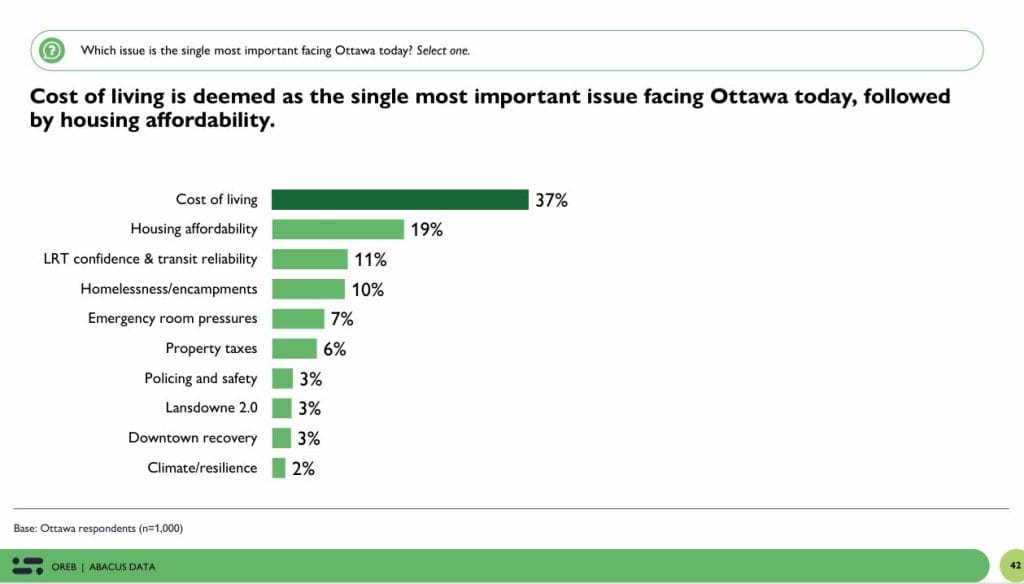
David Coletto, founder and CEO of Abacus Data, said the cost of living, housing affordability and the reliability of services, in that order, topped the concerns of Ottawa respondents to a December survey conducted by Abacus Data for OREB.
Housing has become one of the top three issues for Canadians, said Coletto, and “people are rightly worried. They don’t see as much progress as they’d like. And they start to believe that if the future around housing is unsolved, then their own futures aren’t going to be secure going forward.”
The survey found 74 per cent of respondents believe housing to be unaffordable in Ottawa, 52 per cent say buying a home has become harder over the past year and 57 per cent feel it has become more expensive to rent.
In fact, said Coletto, the cost of both buying and renting has improved, but that’s not the perception. “And if you believe something to be true, it’s much more likely to affect the choices you make in terms of where you live, where you might work, whether you decide to leave the city or not come here at all.”
When asked about solutions for the housing crisis, respondents supported municipal action on reforming development charges (fees on building projects that help pay for municipal infrastructure but which increase the upfront price of a home by as much as $65,000). They also “overwhelmingly” said density near major transit or infrastructure or transportation hubs should be increased, wanted simplified residential zoning, and agreed with faster approval of housing developments.
“Basically, I think, residents want less friction, faster approvals and more housing options in the places that make sense,” said Coletto.
The survey also found that 82 per cent said housing issues will matter in how they vote in October’s municipal election. While housing may be a secondary or tertiary issue for many, he said he suspects that, for those under 40 who may be struggling to buy a home, housing could rank higher.
Coletto also noted the survey found that, while most respondents were still undecided, if the election were held today, Mayor Mark Sutcliffe would win comfortably. As well, most councillors would hold onto their seats, a statement that elicited big grins from a couple of them.
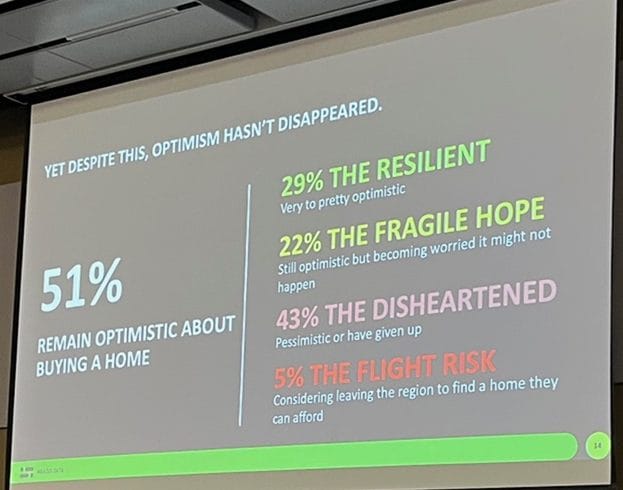
While he said optimism hasn’t vanished from the public outlook, with 51 per cent remaining optimistic about buying a home, Coletto did issue a warning that doubt in the system can lead to people starting to experiment. “They start to do things that they wouldn’t otherwise do. And I’m not going to pass aspersions. Well, maybe I will. A lot of Americans doubt a lot of their system, and you see the kind of politics that they get as a result. That’s why I think, in this country, housing will be one of the most powerful motivators in the next municipal election… It’s not a niche concern. It’s a defining political force.”
MORE: Ottawa survey on the crisis in housing affordability

The mayor’s perspective
Mayor Mark Sutcliffe, largely repurposing his remarks from the recent Mayor’s Breakfast hosted by the Greater Ottawa Home Builders’ Association, pointed to progress being made under the city’s Housing Action Plan with its goal “to make Ottawa the most housing-friendly city in Canada.”
That progress includes:
- deferral (but not elimination) of development charges until later in the homebuying process;
- the removal or narrowing of required, pre-approval studies and reports, such as wind and shadow analyses; and
- the impending new zoning bylaw, which will increase density and height where infrastructure, including public transit, supports it.
The mayor also noted the city’s partnership with the federal government’s Build Canada Homes program to create 3,000 new affordable housing units, with construction beginning this year.
A follow-up Q&A with OREB CEO Nicole Christy included a question about whether the city had plans to add its own land transfer tax to the existing provincial land transfer tax, which can add almost $8,500 to the cost of a $600,000 home.
Reminding his audience that Toronto has its own tax, Sutcliffe said, “We are not allowed to charge a municipal land transfer tax. If we wanted to charge one, then we’d have to go to the provincial government and get them to change the legislation and allow us to do it. So, as of now, we’re not allowed to do it, and I have no plans to ask the provincial government for that.”

Small-town issues
North Grenville Mayor Nancy Peckford and Cornwall Mayor Justin Towndale spoke to a range of housing issues and solutions in their Eastern Ontario small towns. The discussion was moderated by Pauline Auger, past president of the Canadian and Ontario real estate associations, who identified population growth, infrastructure, local services and affordability, along with limited resources and few financial levers, as being among the challenges that confront smaller centres. At the same time, she pointed to the strong connection that often exists between residents and political leaders in small towns.
“Since the pandemic, like many small towns and midsized towns across Eastern Ontario, we’ve experienced accelerating growth,” said Peckford, noting the municipality’s population is now around 20,000. “Seniors were always driving a lot of our growth, but now younger families are coming into the equation.”
That population growth has been especially notable in Kemptville, where developments like eQuinelle, Oxford Village and The Creek by Ottawa builders are drawing commuters, retirees and others.
Cornwall, said Towndale, has seen a fourfold jump in population since 2011 to about 50,000 people today. Previously viewed largely as a retirement community, starting with the pandemic “we saw people selling multimillion dollar homes in Toronto, Montreal, here in Ottawa, wherever the case may be, moving to Cornwall, working remotely. In some senses, we became somewhat of a suburb of both Montreal and Ottawa; we have quite a few commuters on the roads every day.”
Population growth has meant housing challenges in both spots, including a shortage of affordable homes. “It’s no different than larger communities, it’s just the scale,” said Towndale.
North Grenville established an affordable housing task force and strategy, which has led to the possibility of tiny homes (previously “off the table” because of minimum house size requirements, said Peckford), granny suites and more mid-rise, multi-residential projects, including one by Habitat for Humanity.
In Cornwall, where about 70 per cent of residents are renters, the city revamped its housing guidelines in 2021. “We actually started accounting for tiny homes, granny suites, how many units per lot,” said Towndale. Now Cornwall is seeing multi-unit building take off. “We’re starting to see developers come in from the GTA (Greater Toronto Area), more from Ottawa and Montreal, and saying, ‘We want to build in Cornwall’ … There’s interest in 21-storey buildings, 18-storey buildings.”
There’s also a project underway to convert an old school into apartments.
Asked for one strategy they each could recommend to help solve housing issues in other smaller communities, Peckford said social media has helped her communicate more effectively with residents and intervene when appropriate.
Towndale said engaging with other municipalities on common problems like infrastructure can smooth the way to solutions. “When we get together, and we’re advocating for the same points, we get heard louder, and it can make change.”
MORE: 2025 Eastern Ontario Housing Summit tackles housing challenges and solutions
Housing market forecast
Forecasting is always a fraught endeavour, but Shaun Cathcart, senior economist and director of housing data and market analysis at the Canadian Real Estate Association, waded in with a look at what may be coming down the pipe for both the country and Ottawa.
Noting that interest rates are now in “the neutral range” and he’s not expecting any increases in the spring or summer, Cathcart said a feature of this year will be first-time buyers, especially those in the 25-39 age bracket, venturing into the market at a significant rate. “I think we’ve more pent-up demand from first-time buyers than we’ve ever had before. And I think that the conditions might be right for a lot of them to come off … the sidelines.”
Looking at Ottawa, he wasn’t terribly worried about the housing market taking a hit from Prime Minister Mark Carney’s plans to downsize the federal government. He said the cuts to the federal civil service employment over the past year have often been achieved through attrition and early retirement, and that both resale numbers and prices continued to edge up during that time. “So, I just don’t think that that’s as big an issue as it sounded like it might be.”
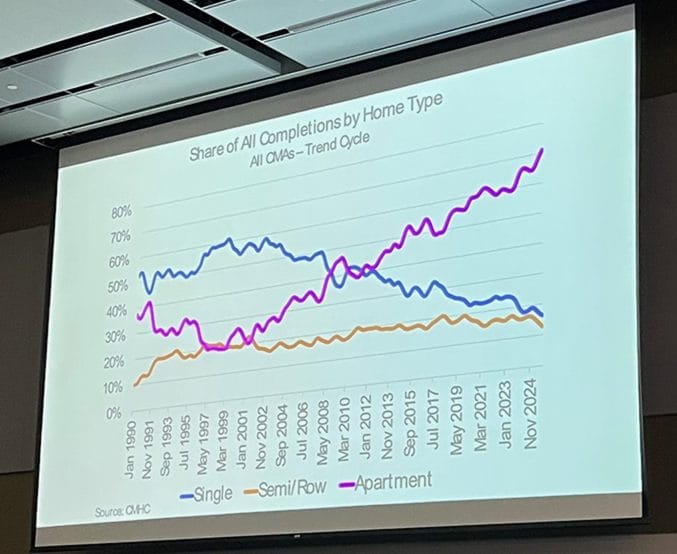
Cathcart also pointed out that Ottawa, unlike many other centres in the country, has seen lots of row and townhomes, often called the “missing middle,” being built, opening up affordability.
While saying he expected the rental market to get “hammered” this year because reduced immigration — typically a source of new renters — has slowed and high interest rates, which kept people out of the market, have declined, Cathcart anticipated an unspecified increase in both resale transactions and prices. That, judging from Realtors’ faces in the room, was excellent news.
Community builders
The symposium’s final session comprised four panellists discussing the “Speed, Supply and Future of Housing.” The panel was moderated by economist Mike Moffat, founding member of the Missing Middle Initiative at the University of Ottawa.
While the panellists’ perspectives and expertise varied, the audience was left with little doubt as to the diversity of housing needs in Ottawa and the manifold challenges of solving them because of financial, systemic and other barriers.
For instance, Greg Finnamore, CFO of Ottawa Community Housing, said there can be a four- to seven-year gap between conception and completion of affordable housing, in part because a lot of federal funding programs are project-by-project, which ends up “disabling speed (when) … data shows we need that supply now.”
MORE: Habitat for Humanity announces its biggest development to date
Sara Cooper, CEO of Habitat for Humanity Greater Ottawa, said that “a lot of the federal funding, at least, has been very focused on funding affordable rentals. And so, where we see a disconnect is, we have people coming to us who want to be homeowners… that disconnect of affordable rental versus affordable homeownership, but also that family-sized, affordable housing is a big gap in our community that we’re trying to address.”
Jason Burggraaf, executive director of the Greater Ottawa Home Builders’ Association, had good words to say about the upcoming zoning changes in Ottawa but pointed to the continuing slowness of getting legal agreements done with the city for a subdivision or site plan. “Each time it’s being approached almost as a unique document that we’ve never written (before),” he said. “So, what we’re trying to do now is push forward with the idea of templated legal agreements to try to speed up that portion of it.”
Panellist Karl Quinn, RBC’s vice-president of real estate markets for Eastern Ontario and northern regions, said restrictions on land supply are gumming up the works. “Land has traded as high as $1 million an acre. That’s just not sustainable to deliver an affordable product on that community, right? And so that’s where you’re seeing a lot of the development outside of our suburban ring, and into outlying communities, where that land cost base is much more affordable, and the associated fees and development charges are (lower).”
Panellists’ potential solutions were equally varied, from increasing homebuilding partnerships with higher levels of government to longer amortizations to allow some would-be buyers to finally get into the housing market.
With additional video remarks from Rob Flack, Ontario’s minister of municipal affairs and housing, as well as in-person comments and a Q&A with Jean Lépine, administrator and acting CEO of the Real Estate Council of Ontario, OREB’s inaugural housing symposium was a well-received, jam-packed affair.