At a market forecast update to the housing industry earlier this spring, Francis Cortellino, a real estate economist at Canada Mortgage and Housing Corporation (CMHC), underlined with hard numbers something the industry had been noticing for some time: single-family home construction is at an historic low (and forecast to remain low) while townhome construction is increasing.
“When you look at Ottawa, what is being built for the missing middle (typically housing that is between single-family homes and high-rises) is mostly only row homes,” he said, while showing a chart of how low housing starts have become in the city, particularly for singles.
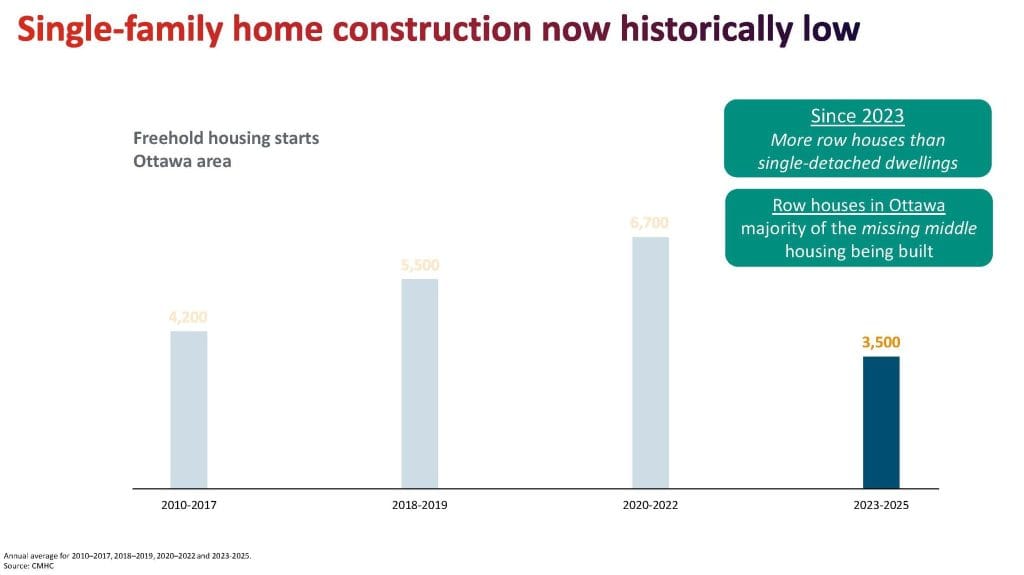
For the first quarter of 2026, he added, there were 390 row home (or townhome) starts and 260 single-detached home starts. CMHC defines a housing start as when the excavation is done and the concrete for the foundation is poured.
Similarly, industry analyst PMA Brethour Realty Group, which publishes monthly new-home market reports in partnership with the Greater Ottawa Home Builders’ Association, has reported that for the first quarter of 2026, there were 456 townhome sales versus 306 single-family home sales. This trend of townhomes claiming at least 50 per cent of the market share has been consistent since 2022. Previously, it was more common to see singles and towns jockeying for the sales lead from month to month.
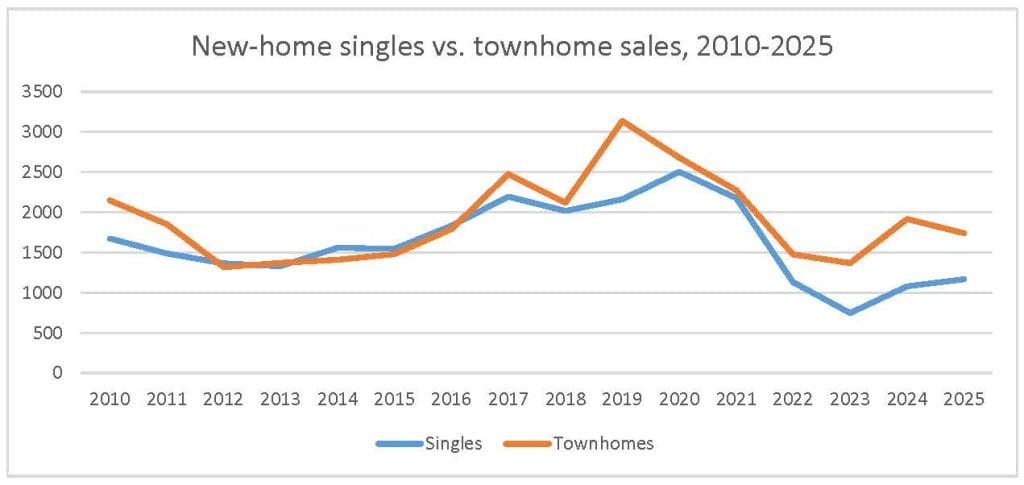
Even in the resale market, there’s evidence of the popularity of townhomes. For instance, in the first quarter of this year, townhome sales rose four per cent versus the same quarter last year, while single-family home and apartment sales dropped by seven per cent and 22 per cent respectively, according to CMHC.
There are several factors at play, including trade tensions, an uncertain economy, lower immigration, municipal policy directives advocating densification in housing, and elevated development charges and construction/land costs leading to significant increases in home prices through the pandemic.
Even though some of those costs have cooled, they did not return to pre-2020 levels, notes Kyrie Warren, sales manager for Tartan Homes, “so the structural cost to build a home levelled out much higher than before.”
Michelle Taggart, president of Tamarack Homes, also points to when the “entire market fell off a cliff” in 2023, thanks to those higher costs coupled with sharp interest rate hikes. “Almost all the builders stopped selling single-family homes. It took several years for material and labour prices to stabilize, and for prices to eventually come back down.
“With higher interest rates between then and now, people have been looking for the best price they could find. The market shifted into townhomes, walk-ups, back-to-back towns and semis. Most of us were doing less than half the sales from the years before.”
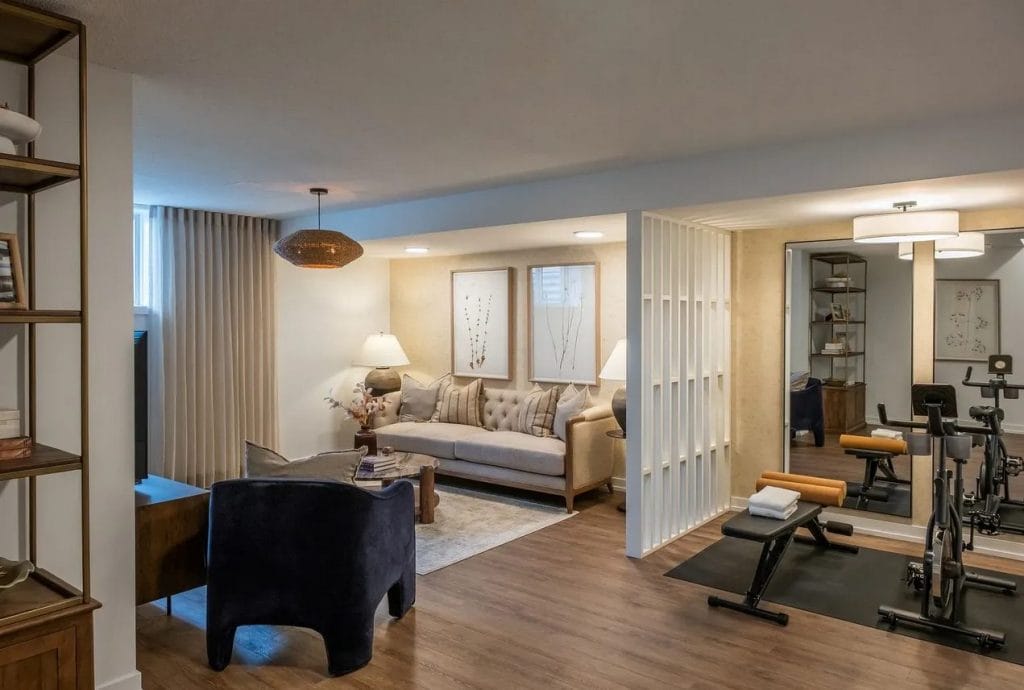
Townhomes, says Cheryl Rice, PMA’s Ottawa president, became “the logical solution because they pack more homes into an acre while still giving families a front door and a backyard.”
But it’s not just about affordability, “though that’s huge,” she says. “Townhomes are the perfect middle ground between condos and detached houses, offering the best balance of space, price and practicality.
“In many Ottawa neighbourhoods, detached homes are simply out of reach for the average professional family, especially with recent high borrowing costs. Yet, buyers still want the privacy, storage and yard space that condos lack. Townhomes hit that sweet spot.”
For many buyers today, townhome ownership “has become the new version of a ‘dream home’ because single‑family homes are no longer financially attainable,” adds Betsy Leeks, sales manager for Cardel Homes. “For first-time buyers, townhomes offer a realistic entry point into the market — giving them the opportunity to start building equity rather than continuing to rent.”
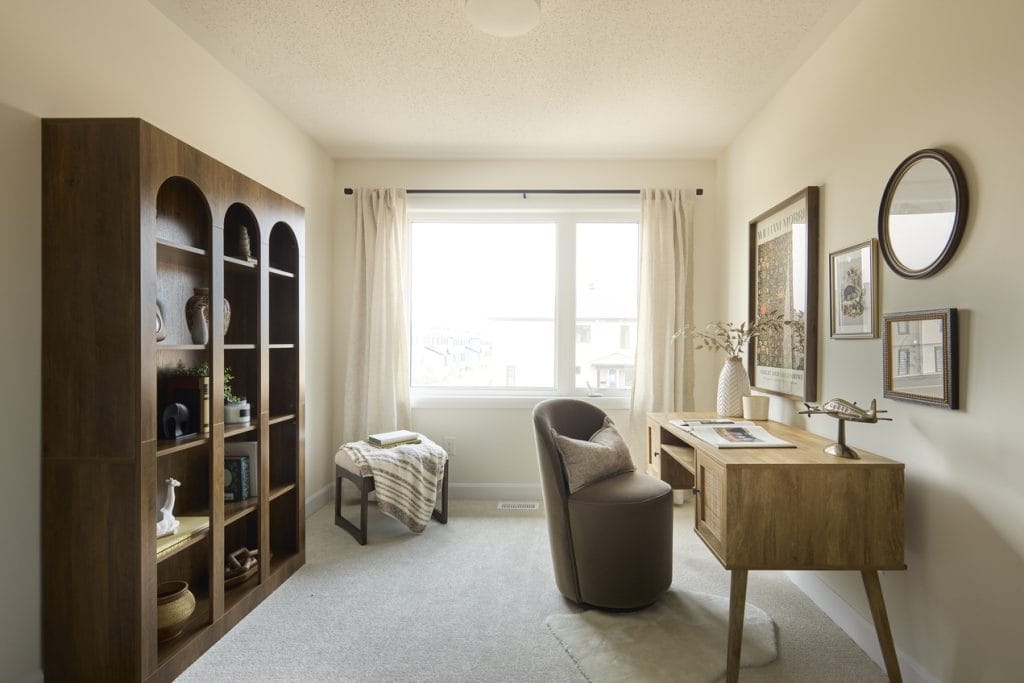
In this market, adds Kristy Brayton, sales and marketing manager at Glenview Homes, “the focus has shifted from ‘detached versus townhome’ to simply achieving homeownership.”
That’s not to say that owning a townhome is a consolation prize.
“They’ve come a long way from what they used to be 20 to 30 years ago,” Taggart says. “They now offer bigger, more thoughtful layouts, with a variety of amenities like finished basements. Builders have really upped their game by reimagining more functional floor plans and offering more space overall; they’ve evolved to become multi-generational.
“It’s just the most affordable way to own a home nowadays.”
Many of today’s townhomes don’t feel like a townhome. “Once you’re inside, once you’re experiencing the layout and the flow and everything the home has to offer, you feel like you’re in a single,” says Melissa Boudreau, director of sales, marketing and product development at Urbandale Construction.
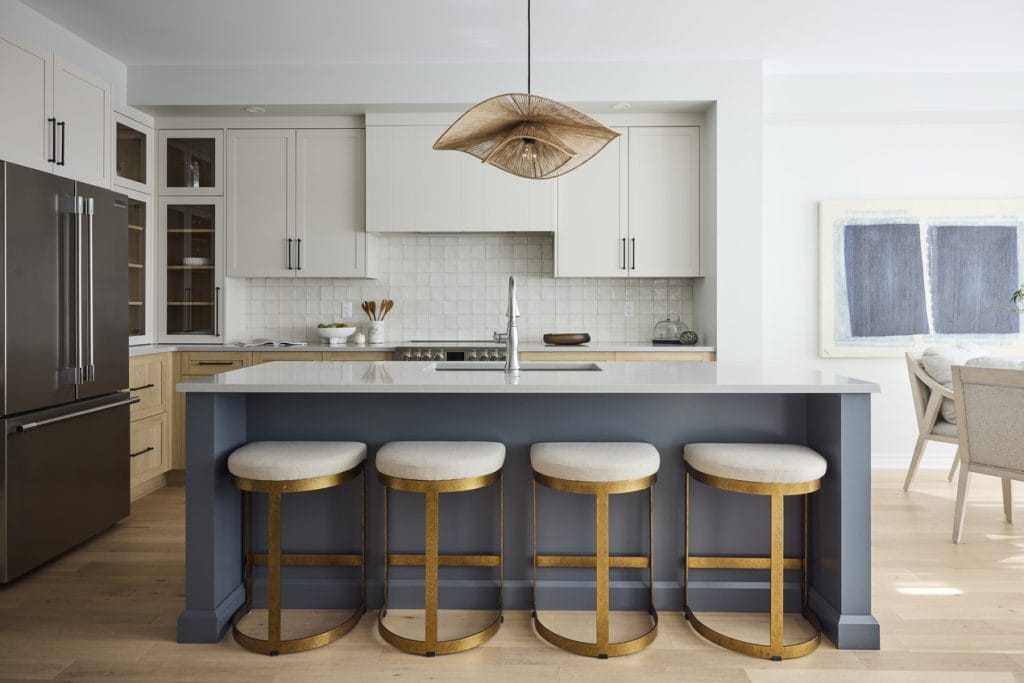
Plus, buyer preferences have changed for some who “prioritize shorter commutes, walkability, efficient floor plans and less maintenance over raw square footage,” says Rice.
“A well-designed townhome in a great Ottawa community is to many buyers an intentional lifestyle choice, not a consolation prize. The dream has simply evolved. Having home equity, stability and a functional space to live matters more than chasing the biggest house on the block.”
Buyer preferences for what’s inside the home have also changed, says Leeks. “Priorities are often on open floor plans with modern, high-end finishes over outdated layouts and materials. Buyers are choosing design, functionality and location over sheer size, making townhomes a very appealing choice.”
Location also plays a major role in the decision to buy, she adds. “With land costs rising, townhomes — at more comfortable price points — are built in desirable areas while singles in the same area are often too expensive. Townhomes allow buyers to live in better locations while still staying within their budget.”
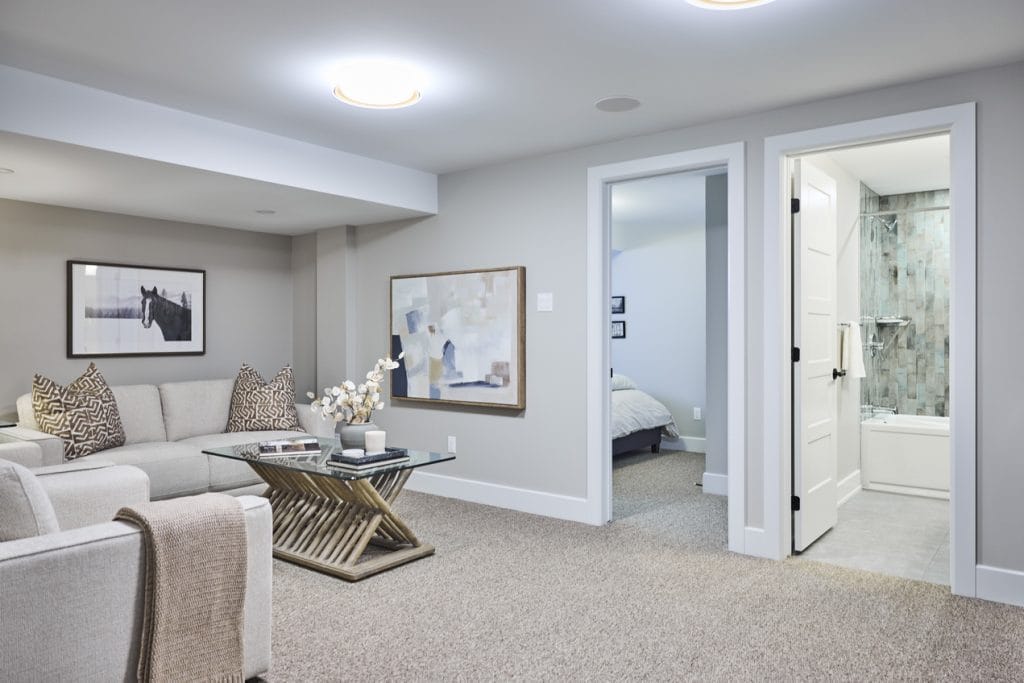
Builders have stepped up, with many offering four or more bedrooms in a townhome, options for multi-generational living, more natural light, flex spaces, creative storage solutions and more.
“Builders have gotten incredibly smart with design,” says Rice. “Their main challenge is balancing these upgrades with affordability. Buyers want home offices, mudrooms and finished basements, but every feature adds to the cost.”
As affordability has become an issue, many builders are offering pared-down traditional townhomes that are more budget-friendly, or variations on the type of townhome — think stacked or back-to-back, for instance — to make homeownership more attainable.
Warren notes that a single-family home may still be a goal for many, but “the timeframe to get there has just been stretched out, or the size of home or lot has decreased.”
Increasingly, adds Brayton, “buyers are resetting expectations and seeing townhomes as a long-term housing solution rather than a temporary compromise. As townhome designs become larger, more functional and more adaptable to changing family needs, buyers are becoming more comfortable staying in them long-term.”
This article ran in the Ottawa Citizen on June 6, 2026.